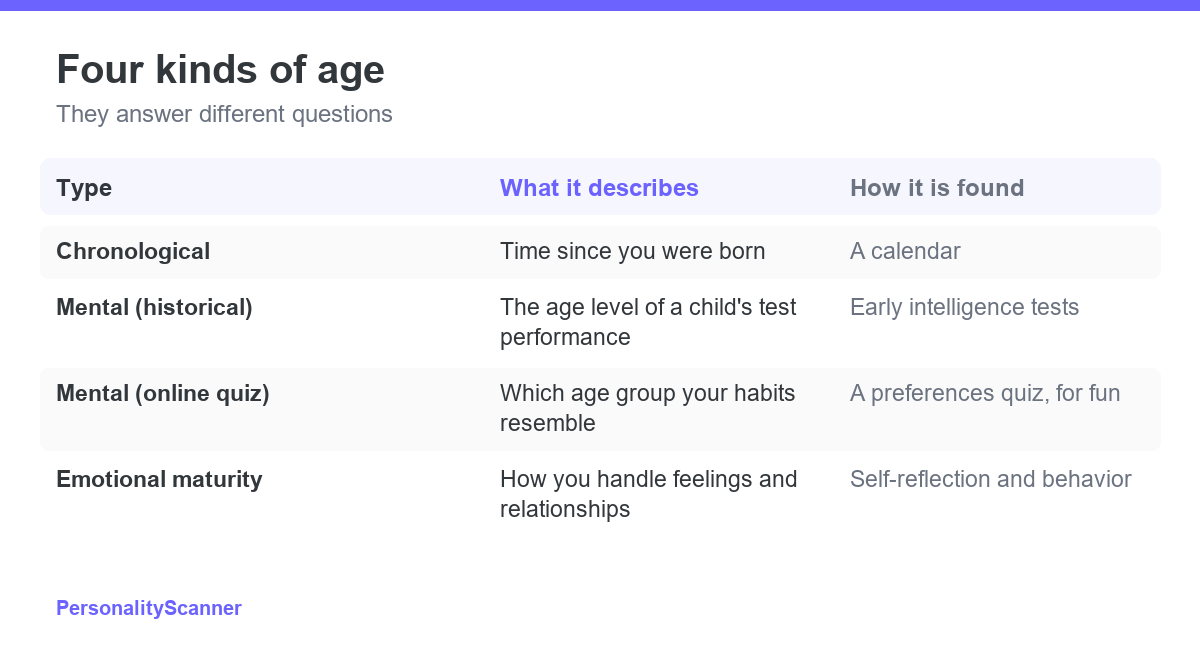
Quick answer: Chronological age is how long you have been alive. Mental age was a term from early intelligence testing: the age at which a typical child would achieve the same score. It was designed for children and does not work for adults. Online mental age tests measure something different — your outlook, habits and preferences — and are for fun, not diagnosis. Take the free mental age test.
“Mental age” sounds like a measurement, something a test could read off like a thermometer. It did begin as a real scientific concept. But what it meant then and what an online quiz means by it now are two different things, and it helps to know which one you are looking at.
Where mental age came from
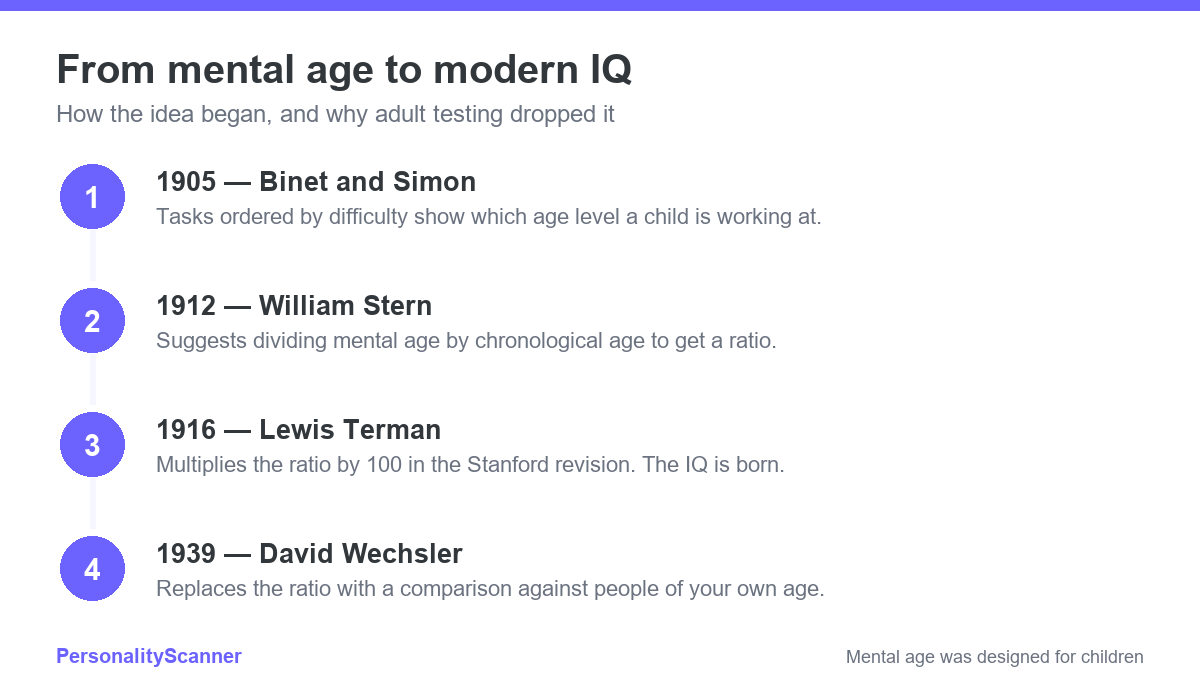
In 1905 the French psychologist Alfred Binet and his colleague Théodore Simon were asked to find a way to identify schoolchildren who needed extra help. They built a series of tasks ordered by difficulty and worked out which tasks a typical child of each age could complete.
A child who passed the tasks that a typical eight-year-old could pass was said to have a mental level of eight, whatever their actual age. A six-year-old with a mental level of eight was ahead; a ten-year-old with a mental level of eight needed support.
Binet was cautious about his own tool. He saw it as a practical way to spot children who needed help, not as a measure of fixed, inborn intelligence.
How mental age became IQ
In 1912 the German psychologist William Stern suggested dividing mental age by chronological age to get a single ratio. Lewis Terman at Stanford adopted the idea in his 1916 revision of Binet’s scale and multiplied by 100 to remove the decimal. The intelligence quotient was born:
IQ = (mental age ÷ chronological age) × 100
An eight-year-old with a mental age of ten scored 125. A ten-year-old with a mental age of eight scored 80. A child exactly on track scored 100.
Why the formula fails for adults
The ratio only works while ability keeps rising with age, which is true in childhood and stops being true afterwards. The kinds of reasoning these tests measure level off by early adulthood, but chronological age keeps climbing.
Apply the formula to a 40-year-old and the result is absurd: someone performing exactly as well as they did at 20 would see their “IQ” halve. There is also no meaningful difference between a “mental age” of 35 and one of 45.
In 1939 David Wechsler replaced the ratio with the deviation IQ used today. Your score no longer compares you with other ages. It compares you with people of your own age, with 100 as the average. Mental age dropped out of serious intelligence testing for adults. We explain modern scores in IQ scores explained, and how scores are compared within each age group in average IQ by age.
So what does an online mental age test measure?
Not what Binet measured. An online mental age quiz asks about your tastes, routines and attitudes — how you spend a free evening, how you feel about new technology, whether you plan ahead or improvise — and maps the answers to the age group they are most typical of.
That makes it a measure of outlook, not ability. A result of 55 for a 30-year-old does not mean anything is wrong, and a result of 22 for a 50-year-old is not a sign of immaturity. It reflects preferences, many of which are shaped by personality and circumstances rather than age.
These quizzes are entertainment. Enjoy the result; do not read a verdict into it.
Mental age is not emotional maturity
People often take a mental age test hoping to learn how mature they are. That is a separate question. Emotional maturity is about how you handle feelings and relationships: taking responsibility, tolerating frustration, seeing another person’s point of view.
Someone can have youthful tastes and be highly emotionally mature, or have very settled habits and struggle with conflict. If maturity is what you are curious about, our maturity test and the guide to emotional maturity are closer to the mark.
Other kinds of “age” you may come across
- Biological age — an estimate of how old your body appears based on health markers. Some methods are research-grade; many consumer versions are rough.
- Subjective age — how old you feel. In a representative Danish sample of 1,470 adults, people over 40 felt on average about 20% younger than their actual age, and a 2014 meta-analysis of long-term studies linked more positive views of one’s own aging with modestly better health and longevity.
- Developmental age — used by pediatric specialists to describe the skills a child has reached, assessed by professionals with standardized tools.
Only the last is a clinical measure, and it applies to children.
A note of caution about the term
“Mental age” has sometimes been used to describe adults with intellectual disabilities, as in “the mental age of a child.” Disability advocates and many professionals discourage this. It reduces an adult with a lifetime of experience to a single misleading number and encourages others to treat them as a child. Describing what a person can do and what support they need is more accurate and more respectful.
Frequently asked questions
What is the difference between mental age and chronological age?
Chronological age is the time since you were born. Mental age was a historical testing term for the age at which an average child would get the same test score. It was meant for children.
Is a mental age test accurate?
Online mental age tests are not scientific instruments. They compare your preferences with typical patterns for different age groups and are best treated as entertainment.
Can your mental age be higher than your real age?
On a quiz, yes — it means your answers resembled those typical of an older group. It says nothing about your intelligence or health.
Do psychologists still use mental age?
Not for adult intelligence. Modern IQ tests compare you with people your own age. Age-equivalent scores are still sometimes reported for children, with care.
Does mental age measure maturity?
No. Maturity is about emotional regulation and responsibility, which a preferences quiz does not assess.
The bottom line
Mental age started as a useful idea for helping schoolchildren and was retired from adult testing more than eighty years ago. Today’s online versions are a lighthearted look at your outlook. Take them in that spirit.
Try the free mental age test and see which age group your habits resemble.
Sources
- Binet A, Simon T. Méthodes nouvelles pour le diagnostic du niveau intellectuel des anormaux. L’Année psychologique, vol. 11 (1904–1905).
- Stern W. The Psychological Methods of Testing Intelligence (1912; English translation by G. M. Whipple, 1914).
- Terman LM. The Measurement of Intelligence, 1916.
- Wechsler D. The Measurement of Adult Intelligence (first published 1939; 1944 edition).
- Rubin DC, Berntsen D. People over forty feel 20% younger than their age: subjective age across the lifespan. Psychonomic Bulletin & Review, 2006.
- Westerhof GJ, et al. The influence of subjective aging on health and longevity: a meta-analysis of longitudinal data. Psychology and Aging, 2014.
Published by the PersonalityScanner Editorial Team. This article is educational and is not a diagnosis or medical advice.