Quick answer: IQ scores are scaled so the average is 100 and about two-thirds of people score between 85 and 115. Roughly 95% fall between 70 and 130, and about 2% score above 130. A score is an estimate with a margin of error of a few points, not an exact figure. Try the free IQ test for adults for a rough indication.
An IQ score is one of the most recognized numbers in psychology and one of the least understood. People ask what a “good” score is as if there were a pass mark. There isn’t. The number only tells you where you sit compared with other people your age.
How IQ scores are scaled
Modern tests such as the Wechsler Adult Intelligence Scale do not measure intelligence in absolute units. They give the same tasks to a large, representative sample of people and then set the scale so that:
- the average score for each age group is 100, and
- the standard deviation — the typical spread around the average — is 15 points.
Scores follow a bell curve. Most people cluster near the middle, and the further you move from 100 in either direction, the fewer people you find.
What the ranges mean
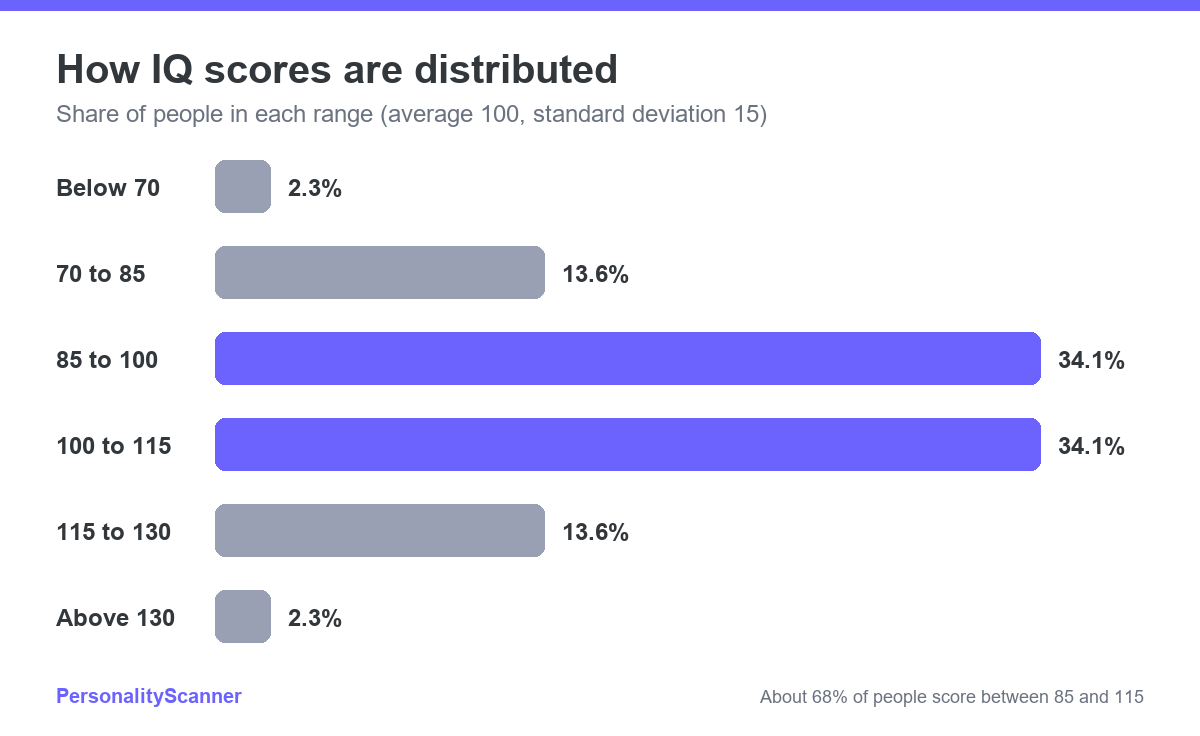
- 85 to 115: about 68% of people. This is the broad middle.
- 70 to 130: about 95% of people.
- Above 130: roughly 2 in 100. Many gifted programs use a cut-off near here.
- Below 70: roughly 2 in 100. A score in this range is one part of how intellectual disability is assessed, alongside everyday functioning. A score alone is never a diagnosis.
Labels such as “average,” “high average” and “superior” vary from one test publisher to another. The percentile is more informative than the label: a score of 115 is at about the 84th percentile, meaning higher than roughly 84 out of 100 people of the same age.
Because every score is compared only with people of the same age, a child and an adult with the same IQ have not answered the same number of questions correctly. We explain how this works for children and teens in average IQ by age, and why the older “mental age” formula was dropped in mental age vs chronological age.
So what is a good IQ score?
Any score from 90 to 109 is squarely average, and half the population is in that band. There is no score that guarantees success and none that rules it out. Whether a score is “good” depends on what you want it for, and for most purposes in life nobody will ever ask.
Your score is a range, not a point
Every IQ test has measurement error. Take the same properly administered test twice and you will rarely get the identical result. Sleep, stress, health, motivation and familiarity with the task format all move the number.
For that reason psychologists report a confidence interval. A reported score of 108 usually means “probably somewhere between about 103 and 113.” Treating a difference of two or three points between people, or between two attempts, as meaningful is a mistake.
What IQ tests measure
A full test combines several kinds of task:
- Verbal comprehension — vocabulary, explaining concepts, general knowledge.
- Perceptual or fluid reasoning — spotting patterns and solving unfamiliar problems.
- Working memory — holding and manipulating information briefly.
- Processing speed — how quickly you handle simple visual tasks.
The overall score is a summary. Two people with the same total can have very different profiles underneath, which is often more useful to know than the headline number.
What IQ predicts, and what it does not
IQ scores do relate to real outcomes. They are among the better single predictors of school grades, and a large review by Frank Schmidt and John Hunter in 1998 found that general mental ability predicts job performance across many kinds of work.
But the relationships are far from perfect, and a great deal lies outside what the tests capture:
- Conscientiousness, persistence and motivation
- Emotional and social skills
- Creativity and practical judgment
- Opportunity, health, education and luck
For a picture of personality rather than reasoning ability, see the Big Five or our guide to emotional intelligence. How the two kinds of ability compare is covered in IQ vs EQ.
Scores have risen over time
In the 1980s the researcher James Flynn documented that average performance on IQ tests rose steadily through the twentieth century in many countries — about three points per decade. This is known as the Flynn effect. Likely contributors include better nutrition, more schooling and greater familiarity with abstract problems.
Two consequences follow. Tests have to be re-standardized every so often to keep the average at 100, so a score depends partly on when the test was normed. And recent research suggests the rise has slowed or reversed in several countries. A 2018 analysis of Norwegian military conscription scores for people born from 1962 to 1991, for example, found a rise, a turning point and then a decline, and traced both trends to environmental rather than genetic causes.
How much to trust an online IQ test
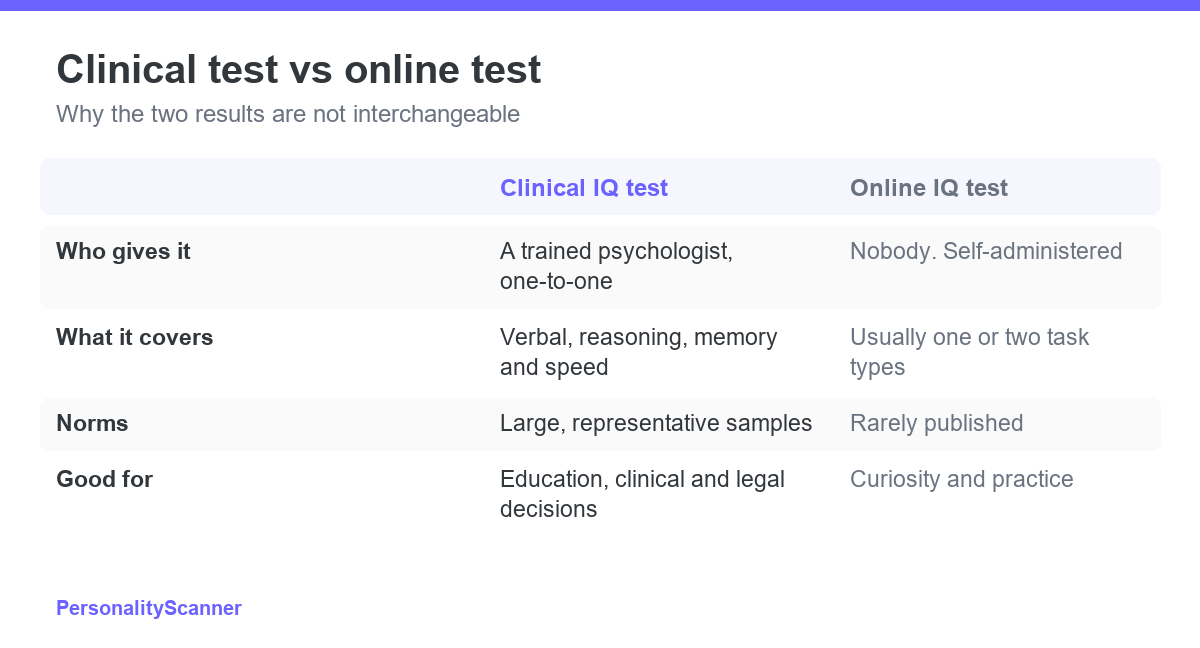
A clinical IQ test is given one-to-one by a trained psychologist, takes an hour or more, and is scored against carefully collected norms. An online test cannot match that. It usually covers one or two kinds of task, nobody checks the conditions, and its norms are rarely published.
Online tests are fine for curiosity and for practicing the question types. They are not suitable for decisions about education, work or health. If a score matters for something real, a licensed psychologist is the right route. Our guide to how much an IQ test costs walks through the options.
Frequently asked questions
What is the average IQ?
100, by definition. Tests are scaled so that the average for each age group is 100.
What IQ is considered gifted?
Many programs use a score around 130, which is about the top 2%. Cut-offs vary between schools and organizations.
Is an IQ of 115 good?
It is above average — higher than roughly 84% of people of the same age.
Can your IQ change?
Scores are fairly stable in adulthood but not fixed. They can shift with education, health and practice at the kinds of task used, and any single result has a margin of error of several points.
Are free online IQ tests accurate?
They give a rough indication at best. Without supervised conditions and proper norms, they cannot match a professionally administered test.
The bottom line
An IQ score places you on a curve relative to your peers, within a margin of error, on a particular set of reasoning tasks. It is useful information and a narrow slice of what a person can do.
Try the free IQ test for adults if you are curious, and read the result as an estimate.
Sources
- Wechsler D. The Measurement of Adult Intelligence (first published 1939; 1944 edition).
- Schmidt FL, Hunter JE. The validity and utility of selection methods in personnel psychology. Psychological Bulletin, 1998.
- Flynn JR. Massive IQ gains in 14 nations: what IQ tests really measure. Psychological Bulletin, 1987.
- Bratsberg B, Rogeberg O. Flynn effect and its reversal are both environmentally caused. PNAS, 2018.
Published by the PersonalityScanner Editorial Team. This article is educational and is not a diagnosis or medical advice.