Quick answer: The idea that you are “left-brained” (logical) or “right-brained” (creative) is a myth. A University of Utah brain-imaging study of 1,011 people found no evidence that individuals favor one hemisphere overall. Both sides work together on almost every task — though specific functions, like language, really are lateralized. Take the free left brain vs right brain test to see which thinking style you prefer.
It is one of the stickiest ideas in popular psychology: accountants and engineers are “left-brained,” while artists and musicians are “right-brained.” It shows up in classrooms, management seminars, and countless online quizzes.
It is also, as a claim about how brains work, wrong. Here is where the idea came from, what neuroscientists actually found when they went looking for it, and what a left-brain/right-brain quiz is genuinely measuring. If you want the practical version, our companion piece lists the signs of a right-brained or left-brained thinking style.
Where the myth came from
The story begins with real and genuinely Nobel-worthy science. In the 1960s, Roger Sperry and Michael Gazzaniga studied patients who had undergone a corpus callosotomy — surgery that severs the thick bundle of fibers connecting the two hemispheres, performed to control severe epilepsy.
With that bridge cut, the hemispheres could be tested separately. The results were striking. Show an object only to the right visual field (processed by the left hemisphere) and the patient could name it. Show it only to the left visual field (right hemisphere) and the same patient often could not say what they had seen — yet could pick the object out with their left hand.
Sperry shared the 1981 Nobel Prize in Physiology or Medicine, receiving half of it “for his discoveries concerning the functional specialization of the cerebral hemispheres.” The finding was real: the hemispheres are specialized, and in most people language production sits mainly on the left.
What happened next was the problem. “Language is left-lateralized in split-brain patients” slowly mutated, through decades of popular retelling, into “logical people use the left half of their brain and creative people use the right.” That second claim does not follow from the first, and nobody ever demonstrated it.
What brain imaging actually found
The decisive test came in 2013. A University of Utah team (first author Jared Nielsen) published an analysis in PLOS ONE using publicly available resting-state functional MRI scans from 1,011 people aged 7 to 29.
They divided the brain’s gray matter into 7,266 regions and asked a direct question: do some individuals show a consistently stronger network on the left, and others a consistently stronger network on the right?
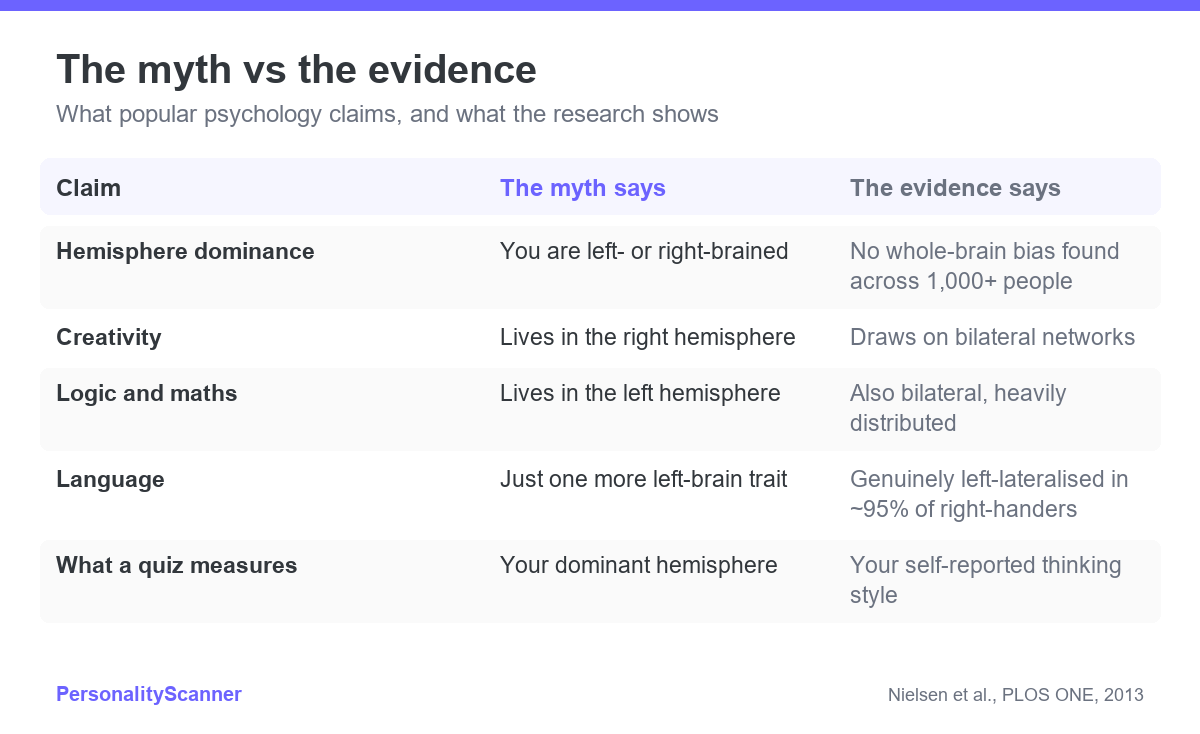
The answer was no. Individual brain regions were clearly lateralized — that part held up. But there was no evidence of a whole-brain bias that would make a person globally “left-brained” or “right-brained.” People did not sort into two camps: someone with a strongly lateralized language network did not also tend to have a stronger left hemisphere across the board. The authors described lateralization as a local property of particular networks, not of a whole brain.
In other words: lateralization of functions is real. Lateralization of personalities is not.
What genuinely is lateralized
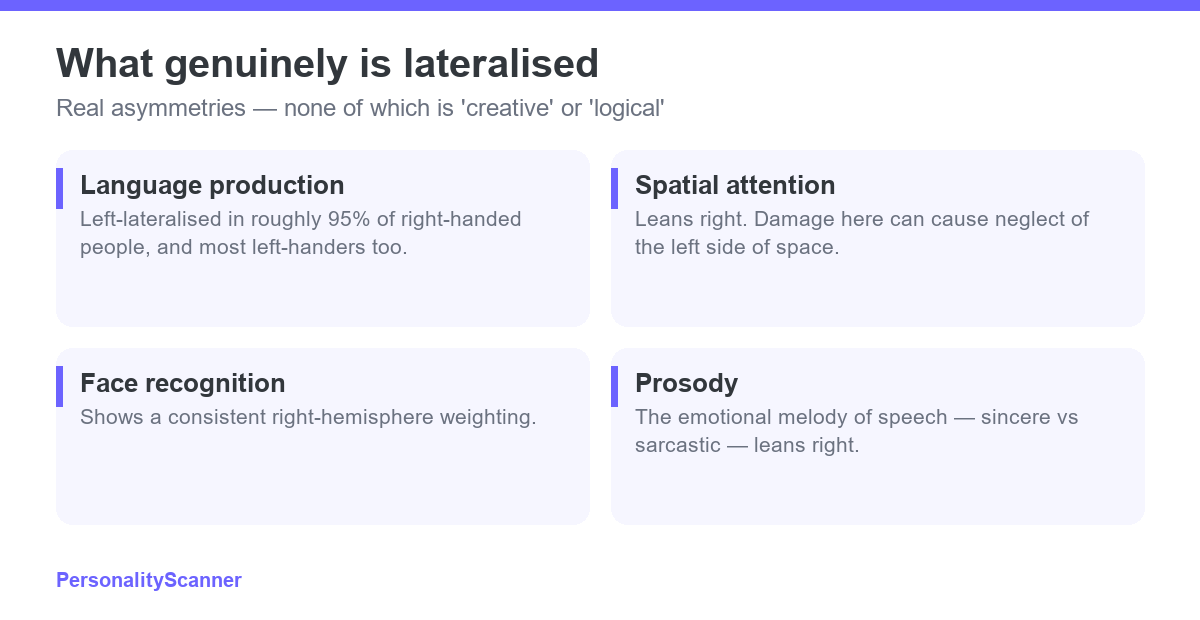
Dismissing the personality myth does not mean the hemispheres are interchangeable. They are not. Neuroscience has mapped real asymmetries — they simply do not map onto “creative versus logical.”
Broadly, and with heavy individual variation:
- Language production is left-lateralized in most people. In a 2000 study of 326 healthy adults, Stefan Knecht and colleagues found right-hemisphere language dominance in only 4% of strong right-handers, rising to 27% in strong left-handers. So even most left-handers are left-dominant for language.
- Spatial attention leans right — which is why damage to the right parietal lobe can cause hemispatial neglect, where a person ignores the left side of space.
- Face recognition shows a right-hemisphere weighting.
- Prosody — the emotional melody of speech, the difference between a sincere and a sarcastic “great” — leans right.
Notice that none of these is “creativity” or “logic.” Those are not single functions living in one place. Creativity draws on memory, association, attention, and motor planning distributed across both hemispheres. So does mathematics. Solving an equation and composing a melody both light up large, bilateral networks.
Why the myth refuses to die
Three things keep it alive.
It is a satisfying story. A two-box explanation for human difference is easy to remember and easy to repeat. “Distributed bilateral networks with regional specialization” does not fit on a poster.
It flatters. Being told you are right-brained sounds like being told you are creative and free-spirited. Being told you are left-brained sounds like being called rigorous and analytical. Both readings are compliments, so few people push back.
It exploits the Barnum effect. This is the well-documented tendency to accept vague, broadly applicable descriptions as uniquely accurate about oneself. Psychologist Bertram Forer demonstrated it in a classroom study published in 1949: he gave every student the same generic personality profile, and most rated it as a highly accurate description of themselves. Statements like “you enjoy structure but also need creative outlets” feel personal while describing almost everyone.
So what does a left brain vs right brain test actually measure?
This is the useful part, and it is why the quiz is still worth taking — as long as you read the result correctly.
A well-built left/right test does not scan your hemispheres. It measures a self-reported thinking-style preference: whether you tend to approach problems sequentially or holistically, whether you prefer verbal or visual representations, whether you like structure ahead of time or prefer to improvise.
Those preferences are real, measurable, and useful. They influence how you like to study, how you organize work, and which explanations click for you. What they do not tell you is which half of your skull is doing more work — because the answer to that is “both, constantly.”
Read your result as “here is the cognitive style I lean toward,” not “here is my dominant hemisphere,” and it becomes genuinely informative. Try the test with that framing in mind.
A better way to think about your thinking
If what you actually want is a map of how you think and behave, these frameworks are far more useful than hemisphere folklore:
- The Big Five (Openness, Conscientiousness, Extraversion, Agreeableness, Neuroticism) is the most empirically supported model in personality research, with decades of evidence for its stability and predictive value. Read our guide to the Big Five.
- Cognitive functions, drawn from Jungian typology, describe preferred modes of processing information rather than brain anatomy. They are a popular framework with less research support than the Big Five. See our explainer on the eight cognitive functions.
- Theories of intelligence describe abilities rather than styles. See the main types of intelligence and how IQ scores work.
Neither claims that half your brain is asleep.
The bottom line
You are not left-brained or right-brained. You have one brain whose regions specialize and whose hemispheres cooperate constantly. What you do have is a thinking style you lean toward — and that is worth knowing, as long as you do not mistake it for neuroanatomy.
Take the free left brain vs right brain test and read the result as what it is: a map of your preferences, not a scan of your skull.
Frequently asked questions
Is the left brain right brain theory completely debunked?
The personality version is. The 2013 Nielsen study of 1,011 brain scans found no whole-brain dominance distinguishing individuals. What remains true is that specific functions — notably language and spatial attention — are lateralized.
Can you be both left-brained and right-brained?
Everyone is. Both hemispheres are active in nearly every task, exchanging information continuously through the corpus callosum. The question is not which side you use but which thinking style you prefer.
Are left-handed people right-brained?
No. Handedness relates to motor control, not personality. Even for language, most left-handed people still show left-hemisphere dominance: in Knecht’s study, right-hemisphere language appeared in 27% of strong left-handers, meaning roughly three in four were still left-dominant.
Why do schools still teach left-brain/right-brain learning styles?
Largely inertia. The idea entered teacher training decades ago and spread widely. A 2008 review by Harold Pashler and colleagues concluded there was no adequate evidence base for using learning-styles assessments in general teaching, because well-designed studies had not shown that matching instruction to a supposed style improves learning.
Does the myth do any harm?
It can. Believing you are “not a math brain” or “not a creative type” becomes self-limiting. Treating the result as a preference rather than a fixed trait avoids that trap.
Sources
- Nielsen JA, Zielinski BA, Ferguson MA, Lainhart JE, Anderson JS, An evaluation of the left-brain vs. right-brain hypothesis with resting state functional connectivity magnetic resonance imaging, PLOS ONE, 2013
- The Nobel Prize, Roger W. Sperry: Facts (Physiology or Medicine 1981)
- Knecht S et al., Handedness and hemispheric language dominance in healthy humans, Brain, 2000
- Forer BR, The fallacy of personal validation: a classroom demonstration of gullibility, Journal of Abnormal and Social Psychology, 1949
- Pashler H, McDaniel M, Rohrer D, Bjork R, Learning Styles: Concepts and Evidence, Psychological Science in the Public Interest, 2008
Published by the PersonalityScanner Editorial Team. This article is educational and is not a diagnosis or medical advice.