
Quick answer: The classic “right-brained” signs are thinking in images, working in bursts of intuition, and preferring open-ended problems. The “left-brained” signs are thinking in words, working step by step, and preferring clear rules. These are real thinking-style preferences — but they are not caused by one hemisphere dominating. Take the free test to see which side you lean toward.
Before the list: one honest caveat that makes everything below more useful.
Neuroscience does not support the idea that some people run on the right half of their brain and others on the left. A study of over 1,000 brains found no such split. What does exist is a genuine difference in how people prefer to process information — and that is what these signs describe. We cover the evidence in detail here.
So read the following as a description of style, not biology. With that framing, it is genuinely useful.
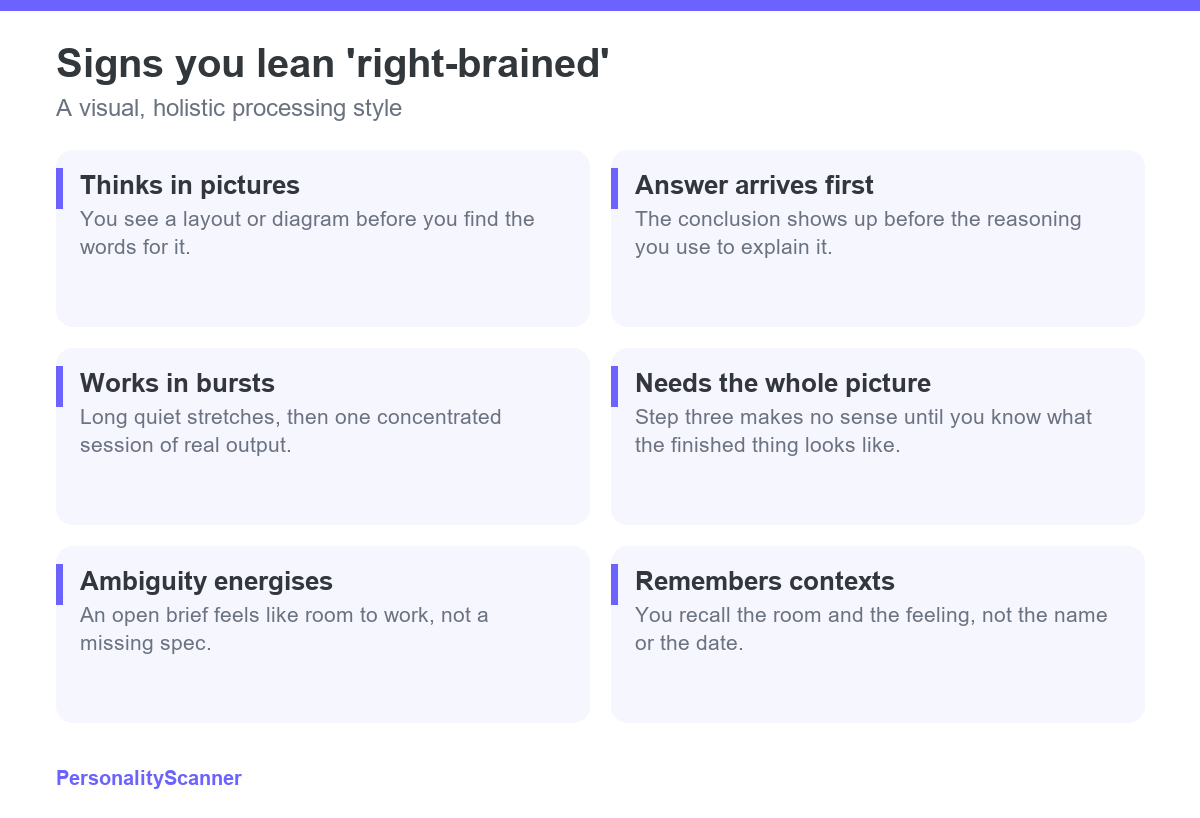
Signs you lean “right-brained”
1. You think in pictures rather than sentences
Asked to plan something, you see a layout, a shape, or a diagram before you find the words. Whiteboards and sketches feel natural; long written specifications feel like a translation exercise.
2. You arrive at answers before you can explain them
The conclusion shows up first, and the reasoning gets reconstructed afterwards. This is not magic — it is pattern recognition running faster than verbal working memory. It feels like intuition because the steps are not consciously available.
3. You work in bursts, not steady increments
Long stretches of apparently nothing, then a concentrated session where most of the work happens. Structured hour-by-hour plans tend to slide off you.
4. You need the whole picture before the details make sense
Being handed step three of a process without knowing what the finished thing looks like is genuinely disorienting. Give you the destination and the steps organise themselves.
5. Ambiguity energises rather than frustrates you
An open brief with no fixed answer feels like room to work. A tightly specified task with one correct output feels like paperwork.
6. You remember contexts and faces better than names and dates
You recall exactly where a conversation happened and what the room felt like, but not the date or the surname. Episodic, sensory detail sticks; discrete labels do not.
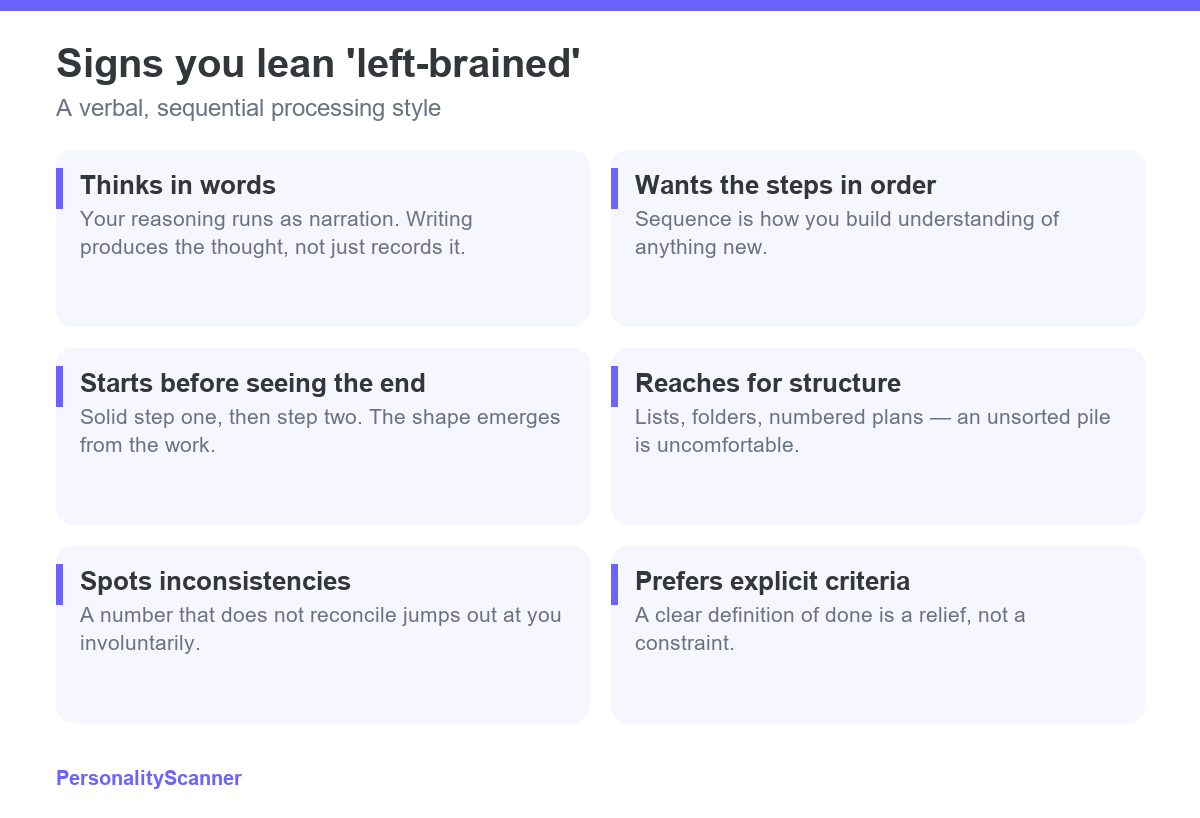
Signs you lean “left-brained”
1. You think in words and talk yourself through problems
Your reasoning runs as an internal narration. Writing something down does not just record the thought — it produces it.
2. You want the steps, in order
Sequence is how you build understanding. A process explained out of order feels broken until you have straightened it out.
3. You are comfortable starting before you can see the end
You do not need the full picture to make progress. Solid step one, then step two, and the shape emerges from the work.
4. You reach for structure by default
Lists, spreadsheets, named folders, numbered plans. Not because you were told to — because an unsorted pile is uncomfortable.
5. You notice inconsistencies quickly
A contradiction between two paragraphs, a number that does not reconcile, a rule applied unevenly. These jump out at you almost involuntarily.
6. You prefer explicit criteria to “use your judgement”
Clear definitions of done are a relief, not a constraint. Vague instructions feel like a trap.
Most people are a mix — and that is the actual finding
If you read both lists and recognised yourself repeatedly in each, you are not confused. That is the normal result, and it is exactly what the neuroscience predicts.
Preferences are also context-dependent. Plenty of people plan a holiday entirely visually and manage a budget in rigid columns. The same person can be intuitive in a familiar domain — where they have enough pattern library to skip steps — and rigorously sequential in an unfamiliar one.
Watch for the Barnum effect here too: descriptions vague enough to fit almost anyone tend to feel uncannily accurate. “You like structure but also value creative freedom” describes most of the human race. The signs above are more specific on purpose, but if a description feels true of literally everyone, it is not telling you much.
How to actually use this
The point of knowing your lean is not to label yourself. It is to change how you work.
- If you lean visual/holistic: demand the overview before starting. Ask for the finished shape, sketch the structure first, and stop apologising for not working in neat daily increments. Give yourself protected blocks instead of scattered slots.
- If you lean verbal/sequential: write the plan before you build. Use your instinct for inconsistency as a review tool. When a brief is vague, invest the time to define done — that is not procrastination, it is how you get traction.
- If you are genuinely mixed: match the mode to the task. Use visual, exploratory thinking to generate options and sequential thinking to evaluate them. Most strong work uses both phases.
The failure mode is forcing yourself permanently into the mode that costs you more effort — then concluding you are bad at the work, when you were only using the wrong approach for how you process.
Frequently asked questions
Can you change from right-brained to left-brained?
You can absolutely develop the skills associated with either style. Someone who thinks visually can learn to write rigorous step-by-step plans. Since there is no fixed hemispheric dominance to begin with, there is nothing biological stopping you.
Are creative people right-brained?
No. Creativity draws on memory, association, attention and motor planning distributed across both hemispheres. Many highly creative fields — architecture, music composition, software — depend heavily on sequential, rule-bound thinking as well.
What if I scored almost exactly in the middle?
That is the most common outcome and it is not a failed result. It means you switch modes depending on the task, which is generally an advantage.
Is one style better than the other?
No. They suit different problems. The value is in knowing which one you default to, so you can deliberately switch when the default is not serving you.
Do these signs predict a good career fit?
Only loosely. Preferences influence how you like to work, not what you are capable of. Broad trait models such as the Big Five have far more evidence behind them for workplace outcomes.
The bottom line
The signs are real; the explanation everyone attaches to them is not. You are not running on one hemisphere. You have a processing style you default to — visual and holistic, or verbal and sequential, or a genuine blend — and knowing which one lets you set up your work to suit it.
Take the free left brain vs right brain test to see where you land, then read what the science actually says so you interpret the score correctly.
Sources: Nielsen JA et al., PLOS ONE, 2013. Forer BR, Journal of Abnormal and Social Psychology, 1949.
Published by the PersonalityScanner Editorial Team. This article is educational and is not a diagnosis or medical advice.