Quick answer: Emotional maturity is the ability to feel your emotions fully while still choosing how you act on them: owning your mistakes, regulating strong reactions and considering other people. It is related to age but not the same thing. Common signs include self-awareness, accountability, empathy and staying steady under stress. Take the free maturity test to see where you stand.
Most of us know people who stay composed in a crisis, apologize without excuses and can hear hard feedback without falling apart, and others who, at any age, struggle with all three. That difference is largely emotional maturity. It is not a formal clinical term, but it overlaps with well-studied ideas: emotion regulation, emotional intelligence and the slow personality changes described by the Big Five personality traits.
What is emotional maturity?
Emotional maturity is the capacity to experience anger, fear or disappointment like anyone else, then pause between the feeling and the reaction, weigh the consequences and respond in line with your values. An emotionally mature person is not someone who feels less. It is someone whose feelings do not make all of their decisions for them.
Psychologists rarely use the phrase itself. The closest research terms are emotion regulation, meaning the ways people influence which emotions they have and how they express them, and the four abilities in Mayer and Salovey’s model of emotional intelligence. Both are learnable.
10 signs of an emotionally mature person
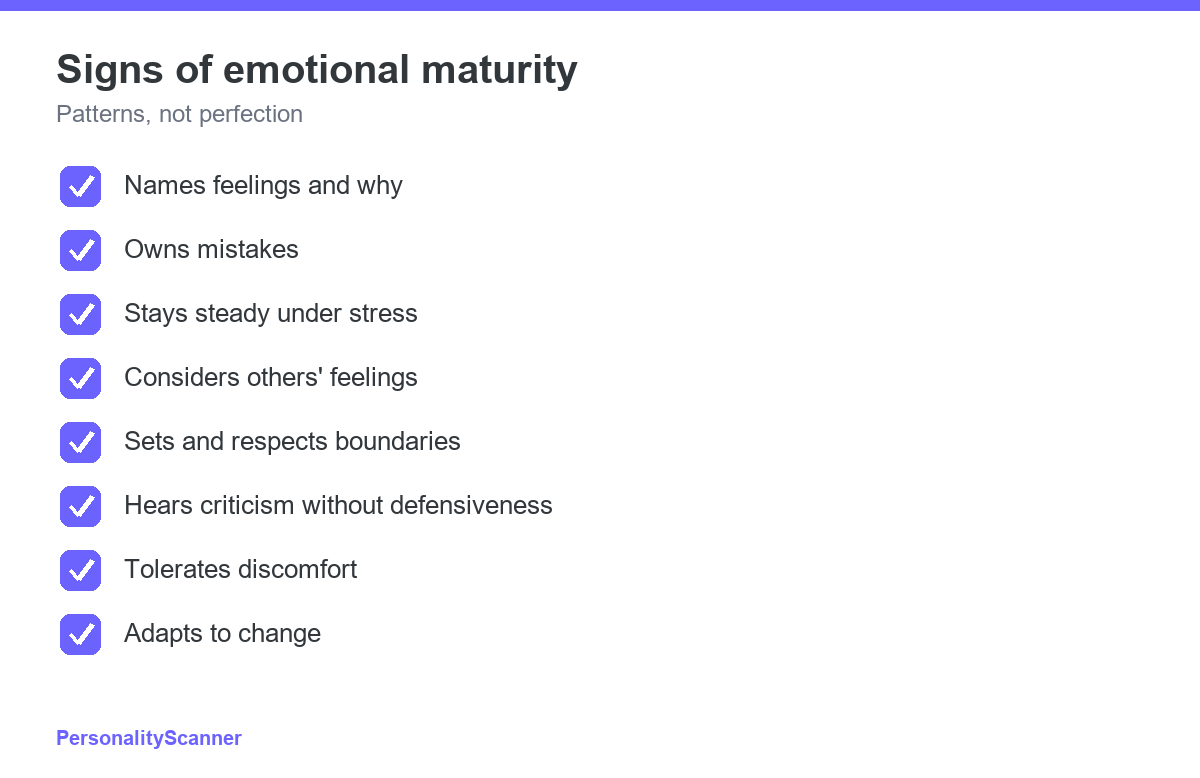
- Self-awareness. They can name what they are feeling and roughly why.
- Accountability. They own their mistakes instead of blaming others.
- Emotional regulation. They stay steady under stress rather than lashing out or shutting down.
- Empathy. They consider other people’s perspectives and feelings.
- Healthy boundaries. They can say no and respect other people’s limits.
- Openness to feedback. They can hear criticism without becoming defensive.
- Patience. They tolerate discomfort and can delay gratification for bigger goals.
- Adaptability. They adjust to change instead of fighting it.
- Independence with connection. They meet their own needs while still valuing relationships.
- Consistency. Their words and actions line up over time.
What does the research say about managing emotions?
Two findings are especially relevant to everyday maturity.
Reappraisal works better than suppression. In a series of five studies, James Gross and Oliver John compared two habits: reappraisal, which means reframing how you think about a situation, and suppression, which means hiding the emotion you feel. People who habitually reappraised experienced more positive and less negative emotion, had better relationships and reported higher well-being. Habitual suppressors felt more negative emotion, not less, and their relationships suffered.
Naming a feeling can calm it. In a 2007 brain-imaging study, Matthew Lieberman and colleagues found that putting feelings into words, which they called affect labeling, reduced activity in the amygdala, a brain region involved in emotional reactions, when people viewed upsetting images. It is one reason “I’m feeling anxious about this meeting” tends to help more than pretending to be fine.
| Situation | Immature response | Mature response |
|---|---|---|
| Critical feedback at work | Arguing, sulking or blaming a colleague | Asking for specifics and deciding what to act on |
| A partner needs space | Reading it as rejection and pushing for reassurance | Naming the worry, then trusting the agreed check-in |
| You made a mistake | Hiding it or explaining why it was not your fault | Owning it early and offering a fix |
| A plan falls through | Venting at whoever is nearby | Feeling the disappointment, then adjusting |
Emotional maturity vs emotional immaturity
Emotional immaturity is not a character flaw. It usually reflects skills that were never modeled or practiced. It tends to show up as impulsive reactions, difficulty taking responsibility, black-and-white thinking and a strong need for outside validation. Our guide to signs of emotional immaturity covers the patterns in detail, including how to respond when you see them in someone close to you.
Maturity is also different from being agreeable or quiet. A mature person can disagree firmly and set limits. What sets them apart is that they do it without contempt and stay open to being wrong.
Is emotional maturity the same as age?
No, but age helps on average. A 2006 meta-analysis of 92 longitudinal samples by Brent Roberts and colleagues found that people tend to become more conscientious and more emotionally stable as they age, with the biggest gains between 20 and 40. Researchers sometimes call this the maturity principle.
Those are averages, and individuals vary widely. Experience builds maturity only when people reflect on it, which is why some 25-year-olds handle conflict better than some 55-year-olds. If you are curious how your outlook compares with your actual age, read mental age vs chronological age or try the mental age test.
How can you become more emotionally mature?
Maturity grows through deliberate practice:
- Name the feeling. Use a specific word before you act.
- Build a pause. Delay replies to heated messages, even by ten minutes.
- Reframe before you react. Ask what else might explain what happened.
- Own one thing. In any conflict, find the part that was yours and say so.
- Repair, do not avoid. Return to difficult conversations once you are calm.
- Ask for honest feedback from someone who will tell you the truth.
Many of these overlap with the habits in our guide to being more likeable. If strong emotions regularly feel unmanageable or are harming your relationships, a licensed therapist can help you build these skills with support.
Frequently asked questions
Is emotional maturity the same as being older?
No. On average people become more emotionally stable between 20 and 40, but individuals vary a great deal. Maturity depends on reflecting on experience, not just having it.
What causes emotional immaturity?
Often it comes from not having emotional skills modeled in childhood, ongoing stress or simply never practicing self-reflection. It can change with effort.
Is emotional maturity the same as emotional intelligence?
They overlap. Emotional intelligence describes abilities such as perceiving and managing emotions. Emotional maturity describes how consistently you use those abilities in daily life, especially under stress.
Can you become emotionally mature as an adult?
Yes. Skills such as reappraisal, naming emotions and repairing conflict can be practiced at any age, and average personality data show continued change well into adulthood.
Is a maturity test accurate?
A maturity questionnaire is an educational self-assessment that reflects how you currently see yourself. Use it as a mirror for growth, not a fixed score or a diagnosis.
Sources
- Gross JJ, John OP. Individual differences in two emotion regulation processes: implications for affect, relationships, and well-being. Journal of Personality and Social Psychology, 2003.
- Lieberman MD, et al. Putting feelings into words: affect labeling disrupts amygdala activity in response to affective stimuli. Psychological Science, 2007.
- Roberts BW, Walton KE, Viechtbauer W. Patterns of mean-level change in personality traits across the life course: a meta-analysis of longitudinal studies. Psychological Bulletin, 2006.
- Brackett M, Delaney S, Salovey P. Emotional intelligence. Noba Textbook Series.
Published by the PersonalityScanner Editorial Team. This article is educational and is not a diagnosis or medical advice.