Quick answer: Research points to a short list of habits that make people more likeable: ask follow-up questions, show warmth before competence, let people know you like them, share a little about yourself, and admit small flaws. Most people are also already better liked than they think. Take the free likeable person test to see where you stand.
Likeability is often treated as a fixed quality: some people have it and the rest of us make do. The research says otherwise. Much of what makes someone easy to like comes down to a handful of behaviors, and behaviors can be practiced.
Here are eight that have real evidence behind them, and what each looks like in an ordinary conversation. Several of them are everyday forms of emotional intelligence, especially reading and responding to how other people feel.
1. Ask follow-up questions
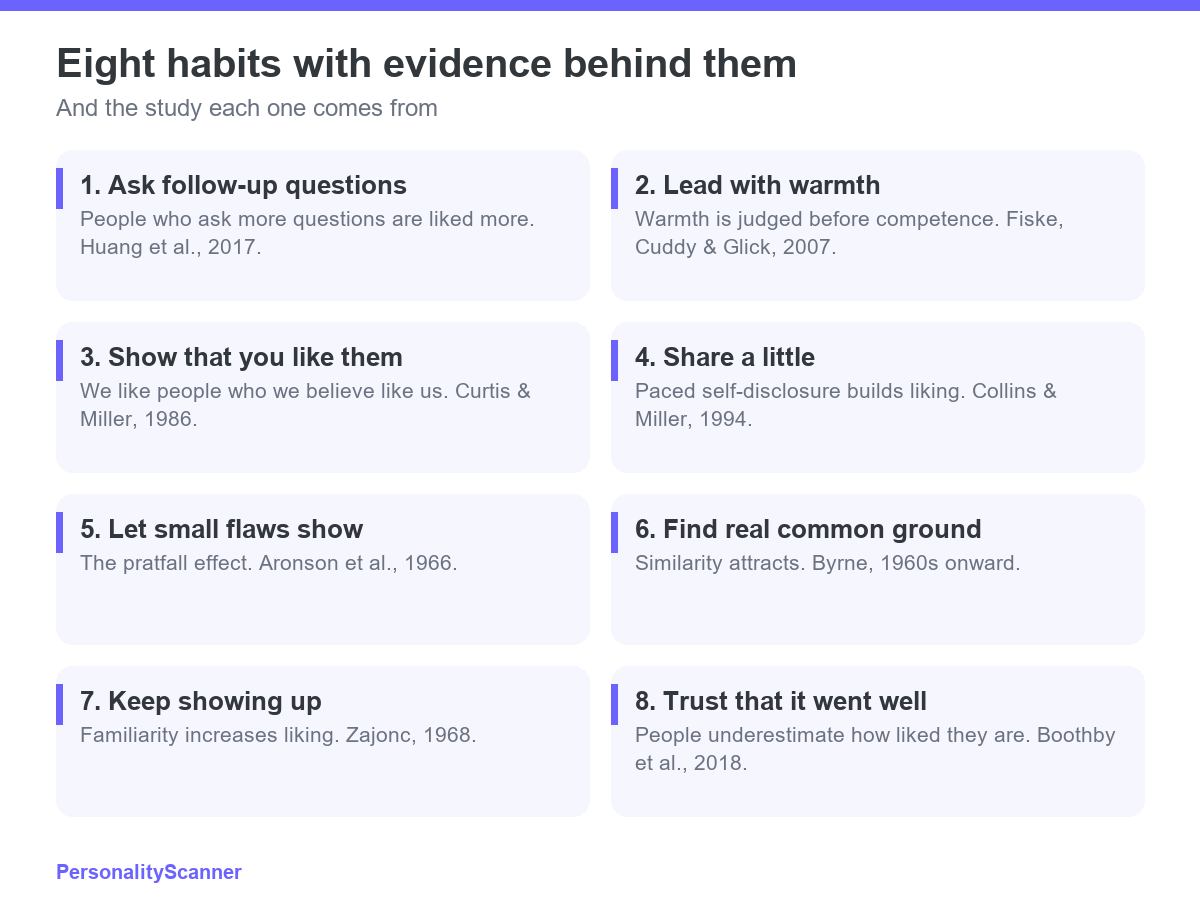
In a 2017 study in the Journal of Personality and Social Psychology, Karen Huang and colleagues analyzed conversations between strangers and found a consistent pattern: people who asked more questions were liked more by their conversation partners. One type did most of the work — the follow-up question, which builds on what the other person just said.
A follow-up question proves you were listening. “How long have you been doing that?” or “What made you switch?” does more for a first impression than any amount of interesting talk about yourself.
2. Lead with warmth
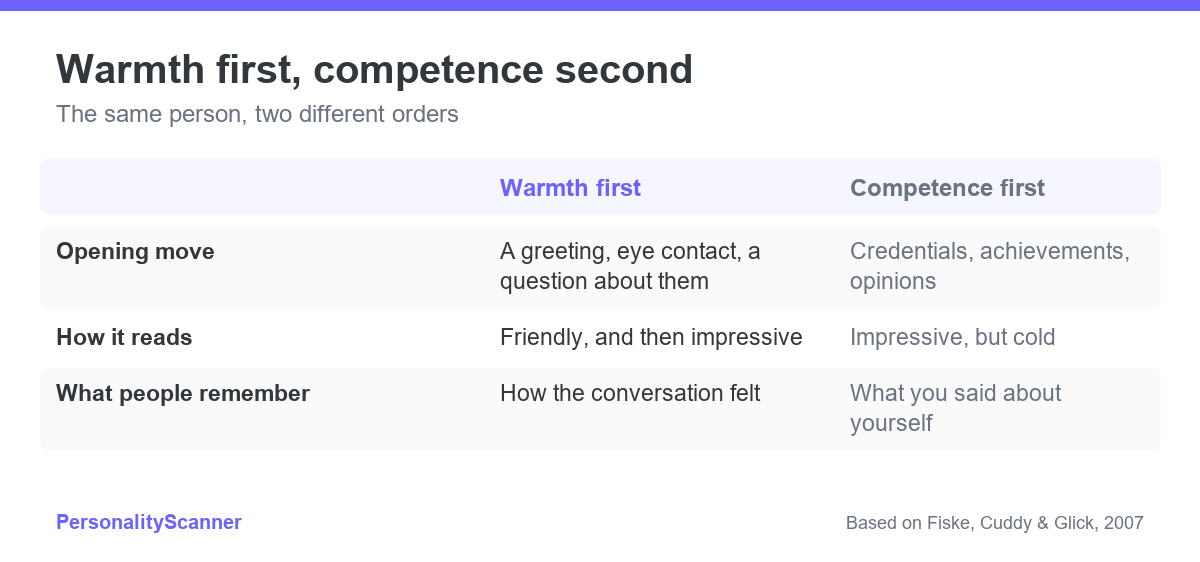
Social psychologists Susan Fiske, Amy Cuddy and Peter Glick have shown that people judge others on two main dimensions: warmth and competence. Warmth is judged first, and it carries more weight in whether we like someone.
In practice this means the order matters. Trying to impress before you have shown friendliness tends to read as cold. A greeting, eye contact and visible interest in the other person come first; your achievements can wait.
3. Let people know you like them
One of the oldest findings in the study of attraction is reciprocity of liking: we tend to like people who we believe like us. In a well-known 1986 experiment, Rebecca Curtis and Kim Miller told participants that a conversation partner either liked or disliked them. Those who believed they were liked behaved more warmly, disclosed more, and ended up being liked more in return — the belief became true.
You do not need to announce it. Being visibly pleased to see someone, remembering what they told you last time, and saying “I enjoyed that” all send the signal.
4. Share something about yourself
A 1994 meta-analysis by Nancy Collins and Lynn Miller pulled together decades of studies on self-disclosure and found three reliable effects: people who disclose more are liked more, people disclose more to those they already like, and people come to like those they have disclosed to.
The key is pacing. Matching the other person’s level of openness, and going slightly further, builds closeness. Unloading very personal material on a new acquaintance does the opposite.
5. Let small flaws show
In 1966 Elliot Aronson and colleagues had participants listen to a recording of a quiz contestant. When a highly capable contestant clumsily spilled coffee on himself, listeners rated him as more likeable than when he made no mistake. This became known as the pratfall effect.
There is a condition attached: it worked for the competent contestant, not the mediocre one. The lesson is not to manufacture mistakes. It is that you do not need to hide ordinary ones. Someone who can laugh at getting lost on the way in is easier to be around than someone presenting a flawless front.
6. Find real common ground
Donn Byrne’s work on the similarity-attraction effect, beginning in the 1960s, showed that people are drawn to those who share their attitudes and interests. The effect has been replicated many times.
This is an argument for curiosity, not for pretending. Faked agreement is usually detectable and costs trust. Asking enough questions to discover a genuine overlap — a shared hometown, the same frustration with a commute, a taste in movies — is the honest version.
7. Keep showing up
Robert Zajonc’s 1968 research on the mere exposure effect found that familiarity alone increases liking. People rated things more positively simply because they had encountered them before.
For relationships, this means consistency beats intensity. Regular, low-stakes contact — the same class each week, a brief chat with a neighbor, turning up to the monthly meeting — builds liking steadily. One caveat: exposure amplifies a neutral or mildly positive first impression. It does not rescue a bad one.
8. Stop assuming people don’t like you
In 2018, Erica Boothby and colleagues published a series of studies in Psychological Science describing the liking gap. After conversations between strangers, people consistently underestimated how much the other person liked them and enjoyed their company. The gap showed up in the lab, in a workshop, and among college roommates over months.
This matters because the belief that you are not liked changes how you behave: you hold back, leave early, and do not follow up. The evidence suggests your first conversations go better than your inner critic reports.
What does not work
- Agreeing with everything. It reads as having no views, and people trust it less.
- Constant self-promotion. Competence without warmth earns respect at best.
- Performing a personality. The effort shows, and it is exhausting to keep up.
- Trying to be liked by everyone. Nobody is. Aiming for it makes you blander, not more likeable.
Likeability is not the same as being nice
Being likeable does not mean having no boundaries. People can disagree, decline requests and give honest feedback while remaining well liked — often more so, because their warmth is believable. If you find yourself agreeing to things to keep the peace, that is a different pattern, and worth looking at separately. Our guide to emotional maturity covers that ground, and social intelligence looks at the wider skill of reading social situations. If closeness itself feels hard, our overview of attachment styles may help explain why.
Frequently asked questions
Can you learn to be more likeable?
Yes. The habits most strongly linked to being liked — asking follow-up questions, showing warmth, appropriate self-disclosure — are behaviors, and behaviors can be practiced.
What is the single most effective habit?
Asking follow-up questions has unusually direct evidence. It is simple, it works with strangers, and it shifts your attention away from how you are coming across.
Why do I feel like people don’t like me?
Possibly because of the liking gap. Studies find that people routinely underestimate how much others enjoyed their company. A persistent, distressing sense of being disliked is worth discussing with a mental health professional.
Are introverts less likeable?
No. Likeability depends on warmth and attentiveness, not on how much you talk. Good listening, which many introverts are strong at, is one of its main ingredients.
Is being likeable the same as being popular?
Not quite. Popularity is about visibility and status. Likeability is about how people feel after spending time with you, and it is the better predictor of lasting relationships.
The bottom line
Be interested before trying to be interesting. Ask, listen, show that you enjoy people’s company, and let yourself be a little imperfect. And give yourself more credit for how your conversations went.
Take the free likeable person test to see which of these habits you already have.
Sources
- Huang K, Yeomans M, Brooks AW, Minson J, Gino F. It doesn’t hurt to ask: question-asking increases liking. Journal of Personality and Social Psychology, 2017 (correction issued 2025 after an independent audit; conclusions confirmed).
- Fiske ST, Cuddy AJC, Glick P. Universal dimensions of social cognition: warmth and competence. Trends in Cognitive Sciences, 2007.
- Curtis RC, Miller K. Believing another likes or dislikes you: behaviors making the beliefs come true. Journal of Personality and Social Psychology, 1986.
- Collins NL, Miller LC. Self-disclosure and liking: a meta-analytic review. Psychological Bulletin, 1994.
- Aronson E, Willerman B, Floyd J. The effect of a pratfall on increasing interpersonal attractiveness. Psychonomic Science, 1966.
- Zajonc RB. Attitudinal effects of mere exposure. Journal of Personality and Social Psychology, 1968.
- Boothby EJ, Cooney G, Sandstrom GM, Clark MS. The liking gap in conversations: do people like us more than we think? Psychological Science, 2018.
Published by the PersonalityScanner Editorial Team. This article is educational and is not a diagnosis or medical advice.