Quick answer: Common bad traits include arrogance, selfishness, unreliability, dishonesty, impulsivity, stubbornness, envy, holding grudges, cynicism and catastrophizing. Below, 18 of them are grouped into social, emotional, behavioral and thinking traits, each with how it shows up and what it costs. Traits are tendencies, not fixed labels, and most can be softened with practice; the free Big Five test is a good place to see your broad tendencies first.
Everyone has a few traits that cause friction. Personality research describes them in terms of the Big Five personality traits: many everyday “bad traits” are what the low end of agreeableness or conscientiousness, or the high end of neuroticism, can look like when they go unchecked. Seeing the link helps, because it tells you which broad tendency to work on rather than a long list of separate flaws.
This page is a catalog of negative personality traits. If you are interested in the moral side (honesty, courage, fairness), see our companion guide to bad character traits. For the patterns that do the most damage in close relationships, see toxic traits.
Which bad traits affect how you treat other people?
Social traits are the most visible, because other people feel them directly.
1. Arrogance
Looks like: talking over people, dismissing their ideas, never asking for help. Cost: people stop sharing information with you, and you stop learning.
2. Gossiping
Looks like: passing on things told in confidence, bonding over criticism of someone absent. Cost: listeners reasonably assume you talk about them too.
3. Selfishness
Looks like: taking the best share, rarely returning favors, showing up only when it helps you. Cost: one-sided relationships that others quietly leave.
4. Judgmentalness
Looks like: snap verdicts about people based on appearance or a single choice. Cost: it closes off connection before it starts.
5. Unreliability
Looks like: canceling late, missing deadlines, forgetting promises. Cost: people stop counting on you and stop inviting you.
6. Condescension
Looks like: explaining what people already know, a patronizing tone, unasked-for advice. Cost: people feel small around you and avoid you.
Which bad traits are about handling emotions?
These overlap with what the Big Five calls neuroticism, the tendency to feel negative emotions strongly. They often grow from earlier experiences, which makes them understandable, not unchangeable.
7. Chronic insecurity
Looks like: constant reassurance-seeking, reading neutral comments as criticism. Cost: it can tire out the people you most want close. If this links to fear of being left, see attachment styles and anxious attachment.
8. Emotional unavailability
Looks like: deflecting with jokes, shutting down in serious conversations, pulling back as intimacy grows. Cost: partners feel lonely even when you are there.
9. Holding grudges
Looks like: reopening old arguments, refusing a sincere apology. Cost: conflicts never actually end.
10. Envy
Looks like: downplaying friends’ wins, feeling bitter when others succeed. Cost: attention goes to other people’s lives instead of building your own.
11. Self-pity
Looks like: seeing yourself mainly as a victim of circumstance and rejecting every suggestion. Cost: it blocks the sense of agency that makes change possible.
Which bad traits show up in how you act?
Several of these sit at the low end of conscientiousness (organization, follow-through, self-control).
12. Laziness or chronic procrastination
Looks like: doing the bare minimum, leaving hard tasks for others. Cost: unfair loads on colleagues and family, and unused potential. Persistent trouble with focus and follow-through can have other causes; our article on ADHD in adults explains when to ask a professional.
13. Dishonesty
Looks like: small habitual lies, exaggerating, taking credit for others’ work. Cost: once a pattern of lying is noticed, trust is slow to return.
14. Impulsivity
Looks like: big decisions on a whim, interrupting, reckless spending, hurtful words in the moment. Cost: instability that makes others anxious.
15. Stubbornness
Looks like: refusing to compromise, sticking with a failing plan out of pride. Cost: avoidable mistakes and frustrated collaborators.
Which bad traits are about how you think?
16. Closed-mindedness
Looks like: dismissing unfamiliar views without hearing them out. Cost: you keep the same blind spots for years. This is roughly the low end of openness to experience; see openness to experience.
17. Cynicism
Looks like: assuming hidden motives behind every kind act. Cost: it erodes relationships, and it may matter for health too. A Finnish study of older adults published in Neurology in 2014 (Neuvonen and colleagues) found that people in the highest third for cynical distrust had about three times the risk of dementia after adjusting for other factors. A link with higher mortality was explained by health, lifestyle and socioeconomic factors, so it should not be read as cynicism shortening life. It is one observational study, not proof of cause.
18. Catastrophizing
Looks like: jumping from a small setback to imagined disaster, “always” and “never” language. Cost: more anxiety and slower decisions.
Are bad traits genetic or learned?
Both. A 2015 meta-analysis by Vukasović and Bratko, pooling behavior genetic studies with more than 100,000 participants, estimated that about 40% of differences in personality between people are linked to genes and about 60% to environment. Genes set tendencies; experience, habits and choices shape how they are expressed.
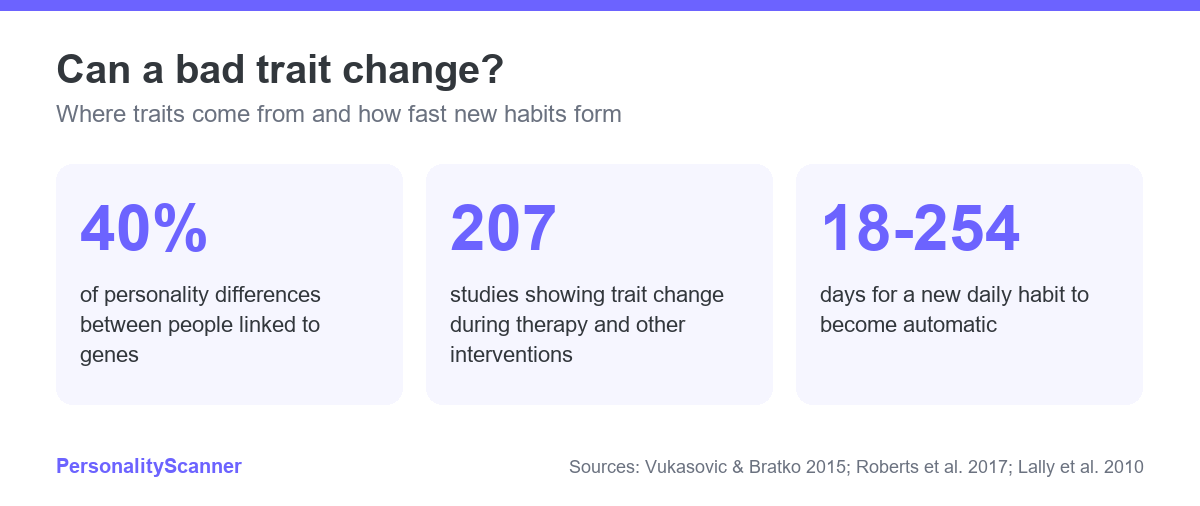
Change is also measurable. A 2017 review of 207 studies by Brent Roberts and colleagues found that personality trait scores, especially emotional stability, shifted noticeably during therapy and other interventions, over an average of about 24 weeks.
How do you change a bad trait?
- Pick one. Choose the trait causing the most harm right now. Working on everything at once rarely sticks.
- Get an outside view. Ask two people you trust which behavior they would most like you to change, and take a trait test for broad context.
- Find the function. Many traits protect something: arrogance can cover insecurity, unavailability can guard against rejection. Knowing what it protects helps you find a safer substitute.
- Replace, don’t just remove. Swap gossip for changing the subject; swap unreliability for calendar reminders and fewer commitments.
- Repeat in the same situation. In a study of habit formation by Phillippa Lally and colleagues, the time for a new daily behavior to become automatic ranged from 18 to 254 days, and missing a single day did not derail the process. Expect weeks to months, not days.
- Get support if it is entrenched. A therapist can help with patterns that keep returning.
Frequently asked questions
What are the worst personality traits to have?
There is no official ranking. Traits that damage trust, such as dishonesty, manipulation, contempt and a lack of empathy, tend to cause the most harm to relationships. Our toxic traits guide covers those in depth.
Can you completely get rid of a bad trait?
Specific behaviors can often be dropped. Broad tendencies, such as a quick temper or a strong worry response, usually soften rather than vanish, but they can be managed well enough that they stop causing harm.
How long does it take to change a negative trait?
Simple habits can take anywhere from a few weeks to several months to become automatic, based on Lally’s research. Deeper shifts, like becoming more emotionally open, usually take longer and benefit from support.
What is the difference between a bad trait and a personality disorder?
A bad trait is a tendency that causes some problems. The American Psychiatric Association describes a personality disorder as a rigid, long-lasting pattern that differs from cultural expectations and causes distress or impaired functioning. Only a qualified clinician can make that assessment.
How do I find out which bad traits I have?
Combine honest feedback from people who know you, a reflective journal of recurring conflicts, and a trait-based questionnaire such as the Big Five test. Look for patterns that repeat across relationships, not one-off incidents.
Sources
- Vukasović T, Bratko D, Heritability of personality: A meta-analysis of behavior genetic studies, Psychological Bulletin, 2015
- Neuvonen E et al., Late-life cynical distrust, risk of incident dementia, and mortality in a population-based cohort, Neurology, 2014
- Lally P et al., How are habits formed: Modelling habit formation in the real world, European Journal of Social Psychology, 2010
- Roberts BW et al., A systematic review of personality trait change through intervention, Psychological Bulletin, 2017
- American Psychiatric Association, What Are Personality Disorders?
Published by the PersonalityScanner Editorial Team. This article is educational and is not a diagnosis or medical advice.