Quick answer: The four color personality types are Red (direct, driven), Blue (analytical, precise), Green (steady, caring) and Yellow (sociable, enthusiastic). The model comes from workplace training tools rather than academic psychology, and almost nobody is one pure color — most people blend two. Take the free color personality test to see your mix.
If you have sat through a corporate training day, you have probably been handed a color. Someone announced you were a Red, or a Yellow, and the room rearranged itself into four corners.
The four-color model is genuinely useful as shared vocabulary. It is also widely misunderstood — including by people who use it professionally. Here is where it comes from, what each color actually describes, and what the model can and cannot tell you.
Where the four colors come from
The model has a real intellectual ancestry, even if the color labels are a later invention.
Carl Jung’s 1921 work Psychological Types proposed that people differ along dimensions of attitude (introversion and extraversion) and function (thinking, feeling, sensation, intuition). That framework influenced a great deal of later personality work, including the MBTI and, indirectly, the color systems.
In the 1920s William Moulton Marston described behavior along two axes — roughly, how assertive a person is and how people-focused they are. That structure became the DISC model, and DISC in turn shaped the commercial color systems used in workplace training today, of which Insights Discovery is the best known.
The important detail: the colors were chosen as a memory aid. They are a way to make a two-axis behavioral model easy to remember and discuss in a room full of people who will never read a psychology paper. They were not derived from any finding that personality is organized into four kinds.
The four colors
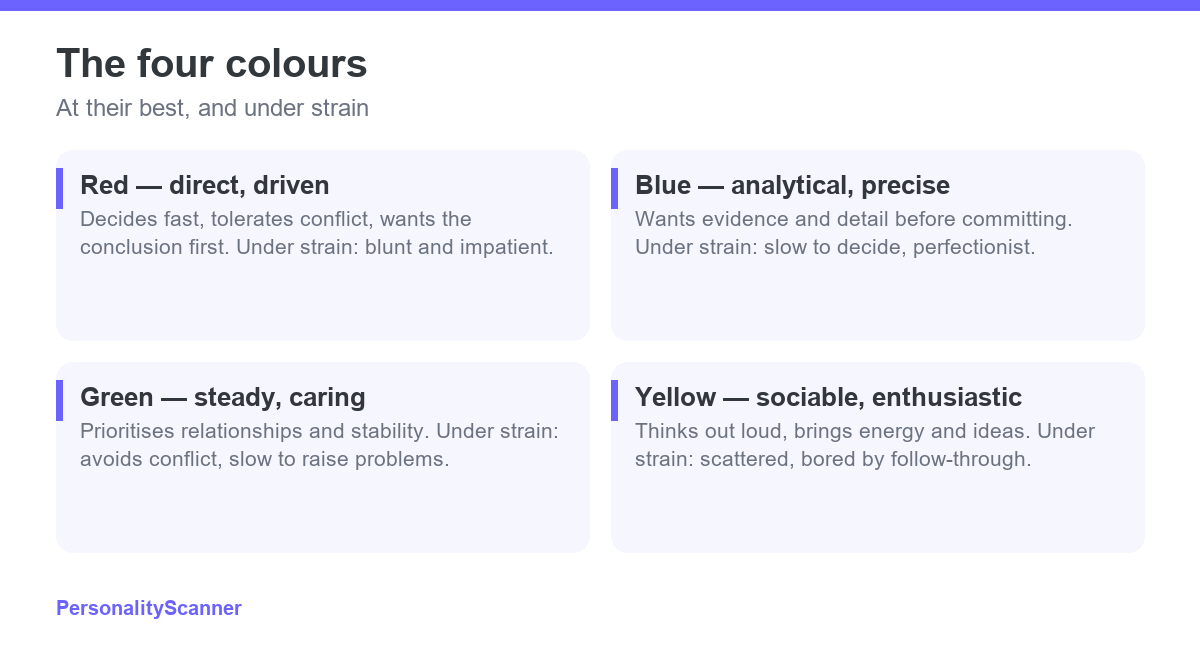
Red — direct and driven
Task-focused and fast-moving. Reds tend to decide quickly, tolerate conflict comfortably, and want the conclusion before the reasoning. They are usually the person who asks “so what are we actually doing?” twenty minutes into a meeting.
At their best: decisive, resilient under pressure, willing to make an unpopular call.
Under strain: impatient, blunt, inclined to steamroll quieter people.
Blue — analytical and precise
Task-focused but slow-moving by preference. Blues want the evidence, the detail and the caveats. They are uncomfortable committing to a position before they have checked it, and they notice inconsistencies that everyone else has skimmed past.
At their best: rigorous, thorough, the person who catches the error before it ships.
Under strain: slow to decide, perfectionist, prone to analysis that never converges.
Green — steady and caring
People-focused and slow-moving. Greens prioritize relationships and stability. They notice when someone in the room has gone quiet, and they will absorb a fair amount of personal inconvenience to avoid a confrontation.
At their best: loyal, patient, the person who holds a team together.
Under strain: conflict-avoidant, slow to raise problems, resistant to change.
Yellow — sociable and enthusiastic
People-focused and fast-moving. Yellows think out loud, generate ideas rapidly, and bring energy into a room. They are usually the reason a meeting was enjoyable and occasionally the reason it achieved nothing.
At their best: persuasive, creative, genuinely good at getting people moving.
Under strain: scattered, over-promising, bored by follow-through.
The two axes underneath
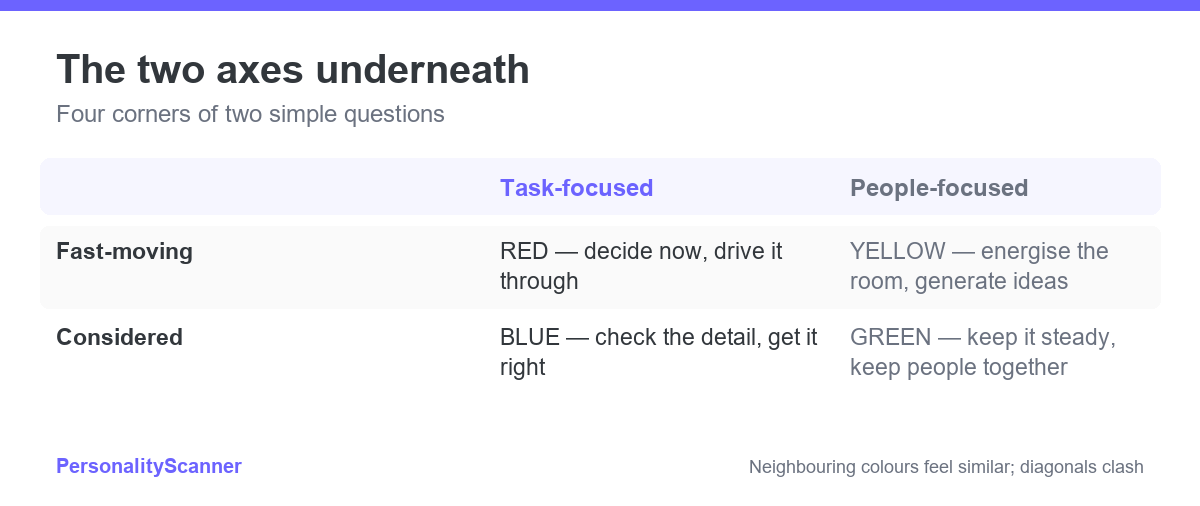
Once you see the structure, the four colors stop looking arbitrary. They are the four corners of two simple questions:
- Fast or considered? Red and Yellow move quickly. Blue and Green take their time.
- Task or people? Red and Blue focus on the work. Green and Yellow focus on the humans doing it.
Red is fast and task-focused. Yellow is fast and people-focused. Blue is considered and task-focused. Green is considered and people-focused. That is the entire model.
This is also why the neighbouring colors feel similar and the diagonal ones clash. Red and Blue share a task focus and argue about pace. Red and Green share almost nothing, which is why that pairing generates the most friction in practice.
Almost nobody is one color
This is the part that gets lost the moment someone is handed a label.
The underlying traits are continuous. You are not assigned to a corner; you sit somewhere on two sliding scales, and where you sit produces a blend. Most people have a dominant color and a clear secondary — a Red-Blue is a very different colleague from a Red-Yellow, even though both are “Reds”.
Your color also moves with context. Plenty of people are a decisive Red at work and a conflict-avoiding Green at home. If a description feels wrong, it is worth asking which version of you was answering the questions.
What the model is good for — and what it isn’t
Being straight about this matters, because the four-color model is often presented with more authority than it has earned.
It is not a validated psychological assessment. The commercial color systems are training tools, not research instruments. Academic personality psychology uses the Big Five, which measures five continuous traits and has decades of evidence behind it. If you want a scientifically grounded picture of your personality, that is the model to use.
It genuinely helps as shared language. Giving a team a common vocabulary for “I need the detail before I can commit” versus “I need the decision now” defuses a lot of avoidable friction. The value is in the conversation, not the accuracy of the label.
It should never be used to sort people. Using a color to decide who gets a role, a promotion or a project is exactly the misuse the model’s own publishers warn against. It describes preference, not capability.
Frequently asked questions
What are the four color personality types?
Red (direct and driven), Blue (analytical and precise), Green (steady and caring) and Yellow (sociable and enthusiastic). They map onto two axes: how quickly someone prefers to move, and whether they focus on the task or the people.
Can you be two colors?
Yes, and most people are. The underlying traits are continuous, so nearly everyone has a dominant color and a secondary one. The blend is usually more informative than the headline color.
Is the color personality test scientifically valid?
No. The color systems are workplace training tools derived from DISC, not validated research instruments. The Big Five is the model academic psychology actually uses.
Which color personality is rarest?
There is no reliable answer, because there is no standard population dataset across the various commercial color systems. Any specific percentage you see quoted should be treated with caution.
Can your color change over time?
Your dominant preference tends to be fairly stable, but it shifts with context and gradually with age. Many people show one color at work and another at home.
The bottom line
Four colors, two axes, and a lot of blending in between. Treat it as a convenient way to talk about working style and it earns its place. Treat it as a scientific measurement of who you are and it will mislead you.
Take the free color personality test to see your own blend, and read the result as a description of preference rather than a verdict.
More on color and personality: What Your Favorite Color Says About You · Color Psychology: What the Research Shows · Take the Color Personality Test
Sources: Jung CG, Psychological Types, 1921. Marston WM, Emotions of Normal People, 1928. Forer BR, Journal of Abnormal and Social Psychology, 1949.
Published by the PersonalityScanner Editorial Team. This article is educational and is not a diagnosis or medical advice.