Quick answer: It depends on the test. Trait-based measures of the Big Five are consistent over time and predict real outcomes such as grades and health, though only modestly. Tests that sort you into a type are weaker, because people near a cut-off can flip categories on a retest. No online test is a diagnosis. Take the free Big Five test for the most evidence-backed option.
“Is this thing accurate?” is the right question to ask about any personality test. It is also the wrong question to ask on its own, because “accurate” hides two different ideas that psychologists keep carefully apart.
Get the distinction and you can evaluate any test you encounter, including ours. For background on the models themselves, see our guides to the Big Five personality traits and the 16 personality types.
What does “accurate” mean for a personality test?
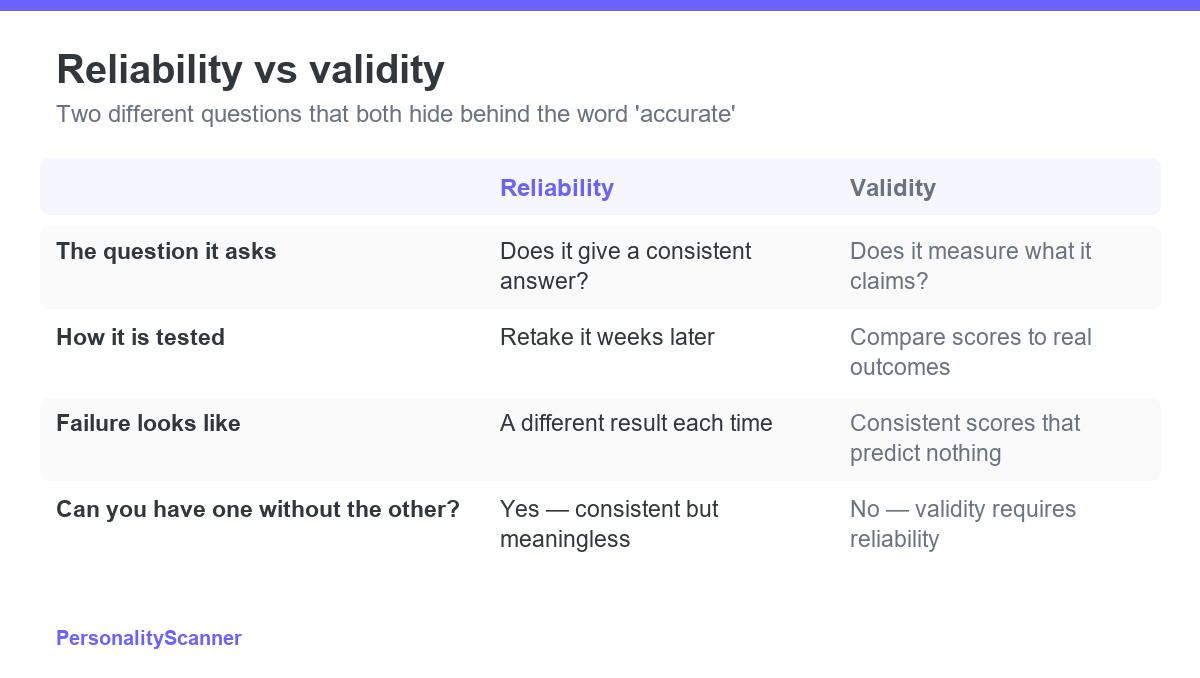
Reliability: does it give a consistent answer?
If you take a test today and again in six weeks, do you get roughly the same result? That is test-retest reliability. A bathroom scale that reads 150 pounds, then 185, then 135 in one morning is unreliable, before you even ask whether it is calibrated correctly.
Validity: does it measure what it claims to?
A test can be perfectly consistent and still measure nothing useful. Predictive validity asks whether scores relate to real outcomes such as grades, job performance, relationships or health. This is the harder bar, and the one where popular tests most often fall short.
A test must be reliable to be valid, but reliability alone guarantees nothing.
How accurate are Big Five (trait) tests?
The Big Five (openness, conscientiousness, extraversion, agreeableness, neuroticism) is the framework academic psychology uses most, and it performs well on both counts.
- The structure replicates. In a 1997 study of 7,134 people tested in six languages, Robert McCrae and Paul Costa recovered the same five-factor structure found in American samples.
- Scores are stable. A 2000 meta-analysis of 152 longitudinal studies by Brent Roberts and Wendy DelVecchio found that test-retest consistency of traits rises from about .31 in childhood to around .74 between ages 50 and 70.
- Scores predict outcomes. A 2009 meta-analysis by Arthur Poropat found conscientiousness predicted academic performance largely independently of intelligence. A 2007 review led by Roberts found personality predicted mortality, divorce and occupational attainment about as well as socioeconomic status and cognitive ability.
None of that makes trait tests perfect. Effects are modest: personality explains part of the variation in life outcomes, not most of it. But as measurement instruments, well-built trait tests hold up.
Why do type-based tests give different results?
Tests that sort you into one of a fixed number of types face a structural problem that has nothing to do with how well they are written.
Traits are continuously distributed. Most people cluster near the middle of any given dimension. A type system has to draw a line and put you on one side of it. If you score close to that line, as many people do, a small change in mood, context or how you read a few ambiguous questions can flip your whole category, even though your underlying score barely moved.
Research backs up the underlying point. In a 1989 study, McCrae and Costa found that the four MBTI scales do measure aspects of four Big Five traits, but found no support for the idea that people fall into truly distinct types. The scores behave like continuous dimensions, which is exactly the situation in which hard cut-offs create unstable labels.
Type systems remain popular for a reason. A four-letter code is memorable and shareable, and it gives people vocabulary for talking about difference. That is a real benefit. It is just not the same thing as measurement accuracy. If you enjoy the type tradition, our cognitive functions guide explains it, and what each MBTI letter means breaks down the code.
The Barnum effect: why an inaccurate result still feels right
In a classroom experiment published in 1949, psychologist Bertram Forer gave 39 introductory psychology students what they believed were individual personality sketches based on a test they had taken a week earlier. Asked to rate how well the sketch revealed their personality on a scale from 0 (poor) to 5 (perfect), the class averaged about 4.3.
Every student had received the same 13 statements, which Forer said came largely from a newsstand astrology book.
The Barnum effect is our tendency to accept vague, broadly applicable statements as specifically true of ourselves. Lines from Forer’s sketch, such as “you have a great deal of unused capacity,” feel personal while describing nearly everyone.
This is the single biggest reason a test can feel uncannily accurate while measuring very little. When you read a result, ask: would this description be false for most people I know? If not, it is not telling you much about you. The same effect explains the appeal of favorite-color personality readings and the left brain vs right brain myth.
How to judge any personality test
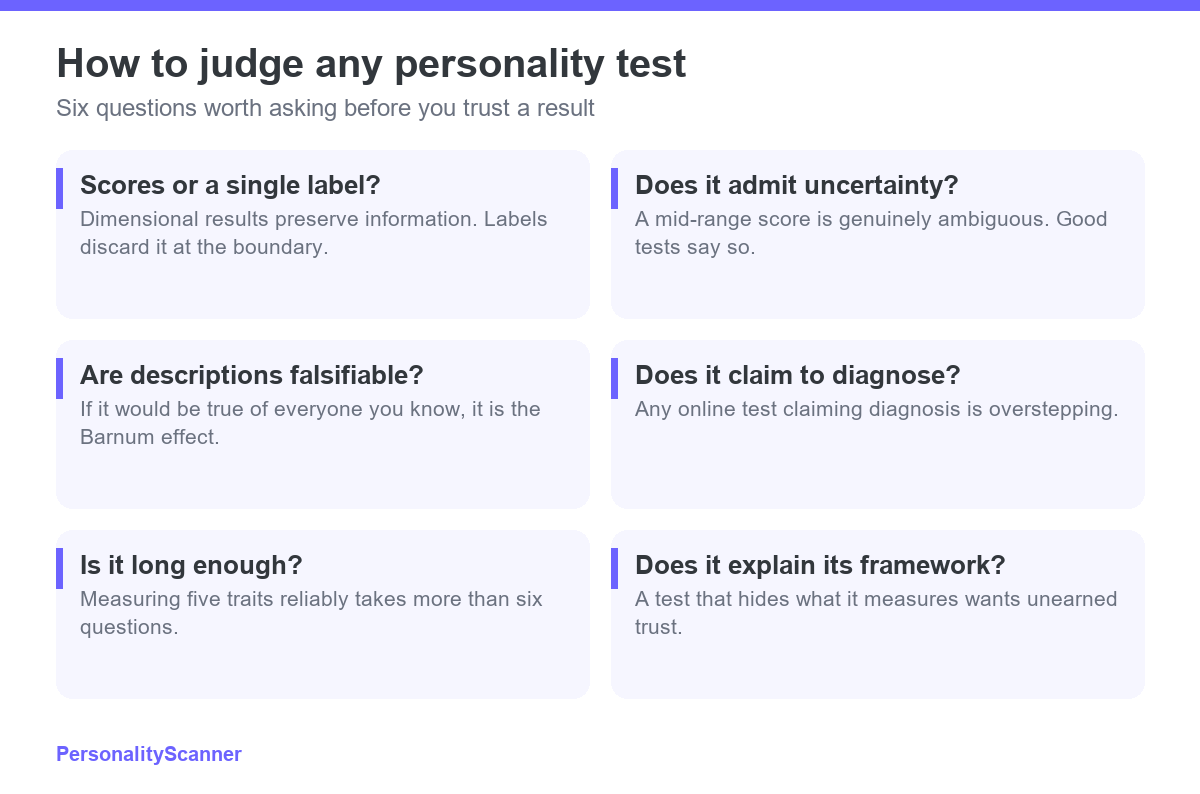
- Does it give you scores on dimensions, or a single label? Dimensional results keep information; labels throw it away.
- Does it acknowledge uncertainty? Good tests say that a score near the middle is genuinely ambiguous. Tests that declare your type with total confidence are overselling.
- Are the descriptions falsifiable? If every description is flattering and could apply to anyone, that is the Barnum effect at work.
- Does it claim to diagnose? Any online test claiming to diagnose a disorder is overstepping. Diagnosis requires a qualified clinician.
- Is it long enough? Reliable measurement of several traits needs a reasonable number of questions. A six-question quiz cannot do it.
- Does it explain what it measures? A test that will not tell you its framework is asking for trust it has not earned.
What are online personality tests good for?
Set against the right expectations, they are useful.
They provide vocabulary: words for patterns you had noticed but could not name. They prompt self-reflection, which has value independent of measurement precision. They offer a starting point for conversations about how you and other people differ. And where they are trait-based and well constructed, they give a reasonable estimate of where you sit relative to other people.
What they cannot do: diagnose a condition, predict your future, choose your career or justify a decision about another person. A result is one noisy data point, collected on a single day and filtered through how you saw yourself that day. That applies to every test on our free tests page, from the Dark Triad test to the IQ test.
How should you read your own results?
Pay attention to extremes, discount the middle. A score near the top or bottom of a scale is more likely to be real and stable. Mid-range scores are the noisiest part of any test.
Look for what surprises you. The parts that match your self-image may just confirm what you already believed. The informative result is often the one you did not expect.
Retake it in a few months. What stays put is signal. What moves a lot was probably mood, context or an ambiguous question you read differently on the day.
Frequently asked questions
Which personality test is the most scientifically accurate?
Among widely available tests, Big Five questionnaires have the strongest research support for both reliability and predictive validity, which is why they dominate academic research.
Why do I get different results each time I take a test?
Usually because your score sits near a category boundary, or because mood and recent events shift how you answer. This is much more visible in type-based tests, where a small shift flips the whole label.
Are free online personality tests reliable?
Some are. Price is not the signal; construction is. A free, well-built trait test with enough items can outperform a paid type test. Judge by the checklist above.
Can a personality test diagnose a mental health condition?
No. A screening questionnaire can suggest that talking to a professional might be worthwhile, but diagnosis requires a qualified clinical assessment.
Does personality change over time?
Yes, gradually. Long-term studies find that people on average become more conscientious and more emotionally stable through young adulthood and middle age, while their ranking relative to peers becomes more stable.
Sources
- Forer BR. The fallacy of personal validation: a classroom demonstration of gullibility. Journal of Abnormal and Social Psychology, 1949.
- McCrae RR, Costa PT. Personality trait structure as a human universal. American Psychologist, 1997.
- McCrae RR, Costa PT. Reinterpreting the Myers-Briggs Type Indicator from the perspective of the five-factor model. Journal of Personality, 1989.
- Roberts BW, DelVecchio WF. The rank-order consistency of personality traits from childhood to old age. Psychological Bulletin, 2000.
- Roberts BW, Walton KE, Viechtbauer W. Patterns of mean-level change in personality traits across the life course. Psychological Bulletin, 2006.
- Poropat AE. A meta-analysis of the five-factor model of personality and academic performance. Psychological Bulletin, 2009.
- Roberts BW, Kuncel NR, Shiner R, Caspi A, Goldberg LR. The power of personality. Perspectives on Psychological Science, 2007.
Published by the PersonalityScanner Editorial Team. This article is educational and is not a diagnosis or medical advice.