Quick answer: ADHD in adults usually shows up as ongoing trouble with attention, organization, time management, restlessness or impulsive decisions that has been present since childhood and causes problems at work, at home or in relationships. About 6% of US adults reported a current ADHD diagnosis in 2023, and more than half of them were diagnosed at 18 or older. Only a qualified professional can diagnose it; our free adult ADHD self-screening quiz can help you decide whether an evaluation is worth pursuing.
ADHD is often thought of as a childhood condition, but many people are not diagnosed until adulthood. They spend years wondering why focus, deadlines or follow-through feel so much harder for them than for others. This guide explains what adult ADHD is, the signs adults commonly describe, how diagnosis works and what to do next. It is educational and cannot diagnose you.
What is adult ADHD?
Attention-deficit/hyperactivity disorder (ADHD) is a neurodevelopmental condition marked by patterns of inattention, hyperactivity and impulsivity. The National Institute of Mental Health (NIMH) stresses the difference from everyday distraction: in ADHD, these behaviors are frequent, show up across many situations and interfere with daily life.
ADHD is not a character flaw or a lack of willpower. Symptoms begin in childhood and often continue into adulthood, but they can change shape. NIMH notes that inattentive symptoms tend to persist while hyperactivity and impulsivity often decline with age, so an adult may feel restless inside rather than visibly bouncing around.
How common is ADHD in adults?
A CDC survey run in October and November 2023 found that about 6.0% of US adults, roughly 15.5 million people, reported a current ADHD diagnosis. Of those, 55.9% were first diagnosed at age 18 or older.
| Finding (US adults with current ADHD, 2023) | Share |
|---|---|
| Adults reporting a current ADHD diagnosis | 6.0% (about 15.5 million) |
| Diagnosed at age 18 or older | 55.9% |
| Receiving no ADHD treatment | 36.5% |
| Receiving both medication and counseling or behavioral treatment | 35.2% |
In other words, an adult diagnosis is common, not unusual. It is never too late to ask for an assessment.
What are the three types (presentations) of ADHD?
Clinicians now talk about presentations rather than fixed types, because the pattern can shift over a lifetime:
- Predominantly inattentive: trouble sustaining focus, losing things, missing details, poor time management and difficulty organizing tasks.
- Predominantly hyperactive-impulsive: restlessness, fidgeting, talking a lot, interrupting and acting before thinking.
- Combined: enough symptoms in both groups.
What are common signs of ADHD in adults?
Adults with ADHD often describe the following. Everyone has some of these sometimes; what matters is how persistent and disruptive they are.
- Chronic disorganization. Lost keys, a messy workspace and forgotten tasks, despite real effort.
- Trouble with time. Underestimating how long things take, running late and relying on last-minute pressure.
- Drifting attention. Zoning out in meetings or losing your place when reading, even when interested.
- Intense focus on interesting tasks. Getting absorbed in something engaging for hours while routine tasks stall.
- Restlessness. Feeling an inner motor running, fidgeting or struggling to relax.
- Impulsive choices. Spontaneous purchases, blurting things out or making big decisions quickly.
- Poor follow-through. Starting many projects and finishing few.
- Strong emotions. Many adults report frustration that flares quickly, though this is not one of the formal criteria.
NIMH notes that adults with ADHD often have a history of school difficulties, work problems or strained relationships.
How is ADHD diagnosed in adults?
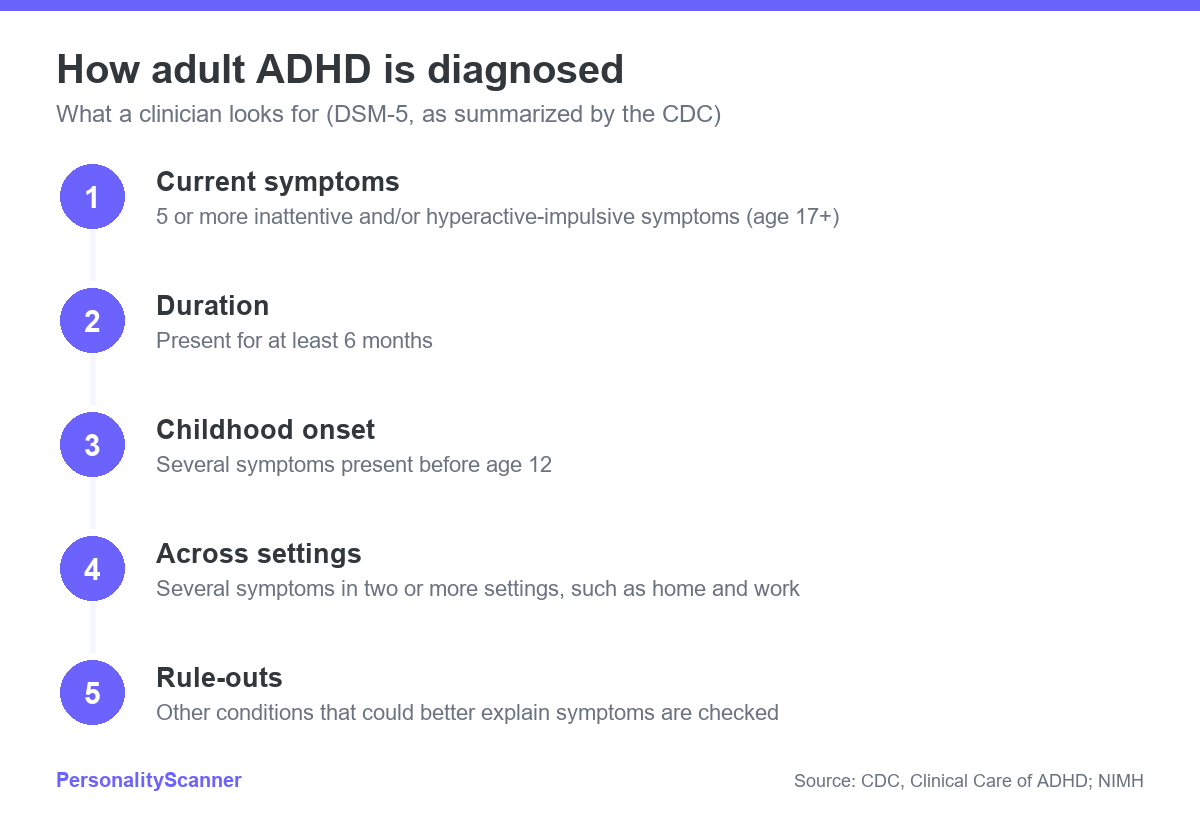
There is no single blood test or brain scan for ADHD. A clinician, such as a psychiatrist, psychologist or other qualified provider, gathers information through interviews, rating scales and, where possible, input from people who know you well or old school records. The DSM-5 criteria summarized by the CDC include:
- Five or more symptoms of inattention and/or hyperactivity-impulsivity for people aged 17 and older (six or more for children up to 16)
- Symptoms present for at least 6 months
- Several symptoms present before age 12
- Several symptoms present in two or more settings, such as home and work
- Clear evidence that symptoms interfere with functioning, and that another condition does not better explain them
Because the childhood requirement matters, NIMH explains that adult diagnosis leans heavily on your history. It also helps to rule out look-alikes: the CDC notes that sleep disorders, anxiety, depression and some learning disabilities can produce similar symptoms.
Can an online ADHD test tell you if you have it?
No, but a screener can help you decide whether to seek an evaluation. The best-known adult screener is the World Health Organization Adult ADHD Self-Report Scale (ASRS). In a 2005 validation study, its six-question screener correctly classified about 98% of participants against clinician diagnoses, while still missing some true cases (sensitivity was about 69%).
Our ADHD self-screening quiz looks at inattention, hyperactivity and impulsivity. Treat the result as a reason to talk to a professional or as reassurance, never as a diagnosis. Bring your answers and real-life examples to the appointment.
What conditions commonly occur with adult ADHD?
NIMH notes that ADHD often co-occurs with other mental health conditions and can make them harder to treat, and that sleep problems are especially common. Anxiety and depression can both overlap with ADHD symptoms, which is one reason a full assessment matters. If low mood is part of the picture, our guide to the stages of depression explains warning signs and when to get help.
What should you do if you think you have ADHD?
- Write down examples. Note how attention, time or impulsivity affect work, money, relationships and home life, and what you remember from childhood.
- Book an evaluation. Start with a primary care provider, psychiatrist, psychologist or specialist ADHD clinic.
- Ask about treatment options. NIMH lists medication (usually stimulants) and psychotherapy such as cognitive behavioral therapy as the most common treatments, often combined. Coaching and exercise may also help.
- Build outside supports. Calendars, reminders, visible to-do lists and accountability partners reduce the load on memory and planning.
- Go easy on yourself. Many adults feel relief when long-standing struggles finally have an explanation.
Curious about broader patterns in how you think and act? The Big Five personality test measures traits such as conscientiousness, and our guide to the Big Five traits explains what they mean. These describe personality, not ADHD.
Frequently asked questions
What does ADHD look like in adults?
Often chronic disorganization, trouble managing time, drifting attention, inner restlessness, impulsive decisions and difficulty finishing tasks. Adults tend to show less visible hyperactivity than children and more internal restlessness.
Can you develop ADHD as an adult?
ADHD begins in childhood; the criteria require several symptoms before age 12. But many people are not diagnosed until adulthood because symptoms were missed, masked by coping strategies or put down to other causes. More than half of US adults with a current diagnosis were diagnosed at 18 or older.
How is adult ADHD diagnosed?
Through a clinical evaluation that covers current symptoms, childhood history, rating scales such as the ASRS and a check for other explanations. For adults, five or more symptoms in a domain, lasting at least six months and present in two or more settings, are required.
What is the difference between ADHD and normal forgetfulness?
Everyone forgets things. ADHD-related forgetfulness and distraction are persistent, show up in several areas of life and cause real problems, such as missed deadlines or bills, despite genuine effort.
Is your ADHD test a diagnosis?
No. It is a self-screening quiz for education. Only a qualified professional can diagnose ADHD.
Sources
- Staley BS et al. ADHD diagnosis, treatment, and telehealth use in adults, United States, October–November 2023. MMWR, 2024
- National Institute of Mental Health, Attention-Deficit/Hyperactivity Disorder
- National Institute of Mental Health, ADHD: What You Need to Know
- CDC, Clinical Care of ADHD (DSM-5 criteria summary)
- CDC, Diagnosing ADHD
- Kessler RC et al. The World Health Organization Adult ADHD Self-Report Scale (ASRS). Psychological Medicine, 2005
Published by the PersonalityScanner Editorial Team. This article is educational and is not a diagnosis or medical advice.