Quick answer: The opposite of narcissism is usually described as echoism: a pattern of avoiding attention, struggling to voice your own needs and fearing you will seem selfish. Echoism is a trait, not a diagnosis. The healthy alternative to both extremes is balanced self-regard with genuine empathy. Take the free Dark Triad test to see where you sit on narcissism.
When people think about the opposite of narcissism, they often picture someone endlessly humble and giving. The psychology is more interesting than that. The true opposite of grandiosity is not perfect selflessness; taken too far, selflessness can become its own problem.
Narcissism is one of the three traits in the Dark Triad, and like the others it runs along a spectrum. This guide covers the low end of that spectrum (echoism), the healthy middle, and the traits most often named as narcissism’s opposites: empathy, humility and altruism.
What is the opposite of narcissism?
There is no single official term, because narcissism in research is a continuous trait rather than a category. Two answers are common:
- Echoism, the low extreme: discomfort with attention and difficulty asserting needs.
- Healthy self-regard, the balanced alternative: confidence without entitlement, and care for others without self-erasure.
Which one people mean depends on whether they are asking about the far end of the spectrum or about the healthiest place to be on it.
What is echoism?
The term comes from the Greek myth of Echo, the nymph who could only repeat the last words of others. Clinical psychologist Craig Malkin introduced “echoism” in his 2015 book Rethinking Narcissism to describe people who sit at the very low end of the narcissism spectrum.
In Malkin’s description, people high in echoism tend to:
- fear seeming narcissistic in any way
- worry about being a burden on others
- feel uncomfortable with praise and attention
- struggle to say what they want when asked their preferences
- listen well but rarely open up about themselves
- blame themselves when others treat them badly
Malkin is clear that echoism is a trait, not a disorder. It does not appear in diagnostic manuals, and it has had little formal research compared with narcissism itself. He describes it as a survival strategy that can develop when an emotionally sensitive child grows up with a parent who shames or punishes the child’s needs, and he links it to insecure attachment. If that pattern sounds familiar, our guide to attachment styles explains the wider picture.
What does the narcissism spectrum look like?
In interviews about his model, Malkin describes narcissism as a spectrum with a healthy middle:
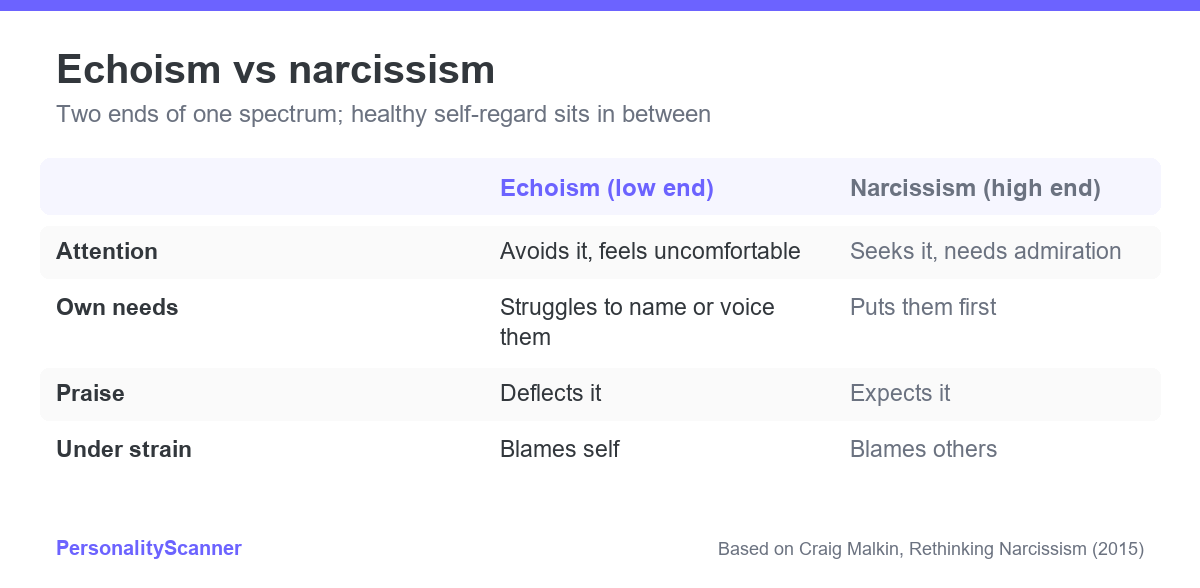
- Echoism (low end): struggling to have a voice of your own, discomfort with any attention, fear of having needs.
- Healthy narcissism (middle): seeing yourself a little more positively than strictly accurate, while still being able to take criticism and admit when you are wrong.
- Narcissism (higher): a strong drive to feel special that starts to crowd out other people, without being a disorder.
- Narcissistic personality disorder (extreme): a need to feel special so strong that love and connection get pushed aside. Only a qualified clinician can diagnose it.
The goal is not to land at either extreme. It is to be able to take up space without taking it from others.
Is empathy the opposite of narcissism?
Empathy is often named as narcissism’s opposite, and research supports a link, but with a twist. Psychologists distinguish two kinds:
- Cognitive empathy: understanding what someone else is thinking or feeling.
- Emotional (affective) empathy: feeling with them and being moved to respond.
A 2014 review by Arielle Baskin-Sommers, Elizabeth Krusemark and Elsa Ronningstam found that narcissistic personality disorder is linked mainly with reduced emotional empathy, while cognitive empathy is often dysfunctional rather than simply missing. In other words, someone high in narcissism may read a room well and still not care much about what they read. The deeper opposite is empathy that is both understood and felt. Our guide to emotional intelligence covers how these skills develop.
Can you be too selfless?
Yes. Barbara Oakley, writing in PNAS in 2013, described pathological altruism: altruism in which attempts to help others end up causing unanticipated harm, to the people being helped or to the helper. Kindness has trade-offs like any other behavior.
Here is how healthy and unhealthy selflessness tend to differ:
| Healthy selflessness | Unhealthy selflessness |
|---|---|
| Helping while keeping clear boundaries | Putting others first to the point of burnout or resentment |
| Enjoying giving without needing credit | Feeling guilty whenever you do something for yourself |
| Saying no when your wellbeing is at stake | Being unable to accept praise, gifts or help |
| Knowing your own values and preferences | Losing your sense of self in relationships |
How does self-compassion fit in?
Self-compassion may be the most practical antidote to both extremes. In a 2009 study of more than 2,000 people, Kristin Neff and Roos Vonk found that self-compassion predicted more stable feelings of self-worth than global self-esteem did, and was less dependent on particular outcomes. Self-esteem, but not self-compassion, was positively associated with narcissism.
That matters for both ends of the spectrum. Someone high in narcissism needs constant external proof of worth; someone high in echoism doubts they deserve any. Self-compassion offers a sense of worth that does not have to be earned or defended. Our article on self-esteem vs self-worth explores the difference.
How to find balance on the narcissism spectrum
- Practice stating small preferences. Choose the restaurant or the movie. For people high in echoism, low-stakes practice builds the habit.
- Accept a compliment with “thank you.” No deflecting, no returning it immediately.
- Set one boundary and notice what happens. Usually, far less than you feared.
- Check your motives when helping. Are you giving because you want to, or because you fear rejection if you do not?
- Ask for honest feedback. A trusted friend or therapist can show you which direction you lean.
If these patterns are causing real distress or keeping you in harmful relationships, a licensed therapist can help you work through them.
Frequently asked questions
What is the clinical term for the opposite of narcissism?
There is no official clinical term. “Echoism,” introduced by psychologist Craig Malkin in 2015, is the most widely used name for the low end of the narcissism spectrum, but it is a descriptive trait, not a diagnosis.
Is being the opposite of a narcissist a good thing?
Not necessarily. Empathy and generosity are strengths, but at the extreme they can become self-silencing. The healthiest position is balanced self-regard, not zero self-regard.
Is the opposite of narcissism the same as being an empath?
Not exactly. “Empath” is a popular term rather than a research construct. Strong empathy is one part of the opposite of narcissism, but so are humility, the ability to voice your own needs and a stable sense of self-worth.
Can people high in narcissism develop empathy?
Research suggests empathy in narcissism is often dysfunctional rather than completely absent, which leaves room for change. Change usually requires genuine motivation and, for clinical-level problems, professional help.
How do I know if I am an echoist?
Common signs include feeling uncomfortable with attention or praise, struggling to name your own preferences, fearing you are a burden and blaming yourself when others treat you badly. If these resonate, a mental health professional can help you explore them.
Sources
- Malkin C. 9 things everyone should understand about echoists. Psychology Today, 2018.
- Malkin C. Rethinking Narcissism. Harper Wave, 2015 (catalog record).
- theSkimm. Healthy narcissism, with comments from Craig Malkin.
- Baskin-Sommers A, Krusemark E, Ronningstam E. Empathy in narcissistic personality disorder: from clinical and empirical perspectives. Personality Disorders, 2014.
- Oakley BA. Concepts and implications of altruism bias and pathological altruism. PNAS, 2013.
- Neff KD, Vonk R. Self-compassion versus global self-esteem: two different ways of relating to oneself. Journal of Personality, 2009.
- Paulhus DL, Williams KM. The Dark Triad of personality. Journal of Research in Personality, 2002.
Published by the PersonalityScanner Editorial Team. This article is educational and is not a diagnosis or medical advice.