Quick answer: Very little. A 2021 study that tested 11 popular “favorite color means” claims against standard personality scores found support for none of them. Color preference mostly reflects what you associate with a color — places, objects, memories and the groups you belong to — rather than your traits. Take the free color personality test for a fuller picture than one color can give.
Search for what your favorite color says about you and you will find confident answers. Blue means you are calm and trustworthy. Red means you are passionate. Black means you are sophisticated, or possibly troubled, depending on which page you landed on.
The confidence is the tell. If the meaning of a color were a stable fact about personality, different sources would agree — and they do not. Below is what the research actually finds, and what your favorite color can honestly tell you. For a model of personality that does hold up, see our guide to the Big Five personality traits.
Does your favorite color reveal your personality?
The most direct test so far says no. In 2021, researchers at the University of Lausanne collected claims from popular color-personality websites and turned them into 11 testable predictions — for example, that people who prefer red, orange or yellow are more extraverted. They then compared the favorite and least favorite colors of 323 adults with scores on a standard six-factor personality model.
None of the 11 predictions held up, and an exploratory analysis found no link between color preference and personality traits at all. The authors’ title summed it up: “Not much.”
One study of French-speaking adults is not the final word. But when specific, testable versions of the popular claims fail outright, the burden of proof sits with the websites making them.
What is the most popular favorite color?
Blue, and this is one of the more consistent findings in the area. A 2015 YouGov survey in ten countries across four continents found blue was the top choice in every one of them, picked by between 23% (Indonesia) and 33% (Great Britain) of respondents.
Lab studies agree. When Stephen Palmer and Karen Schloss at UC Berkeley had 48 adults rate 32 colors, average preference peaked at blue and dropped lowest around dark yellow and olive.
That popularity creates a problem for the premise. If roughly a quarter to a third of people name the same favorite color, that color cannot be telling you much that distinguishes one of them from another.
What actually drives color preference?
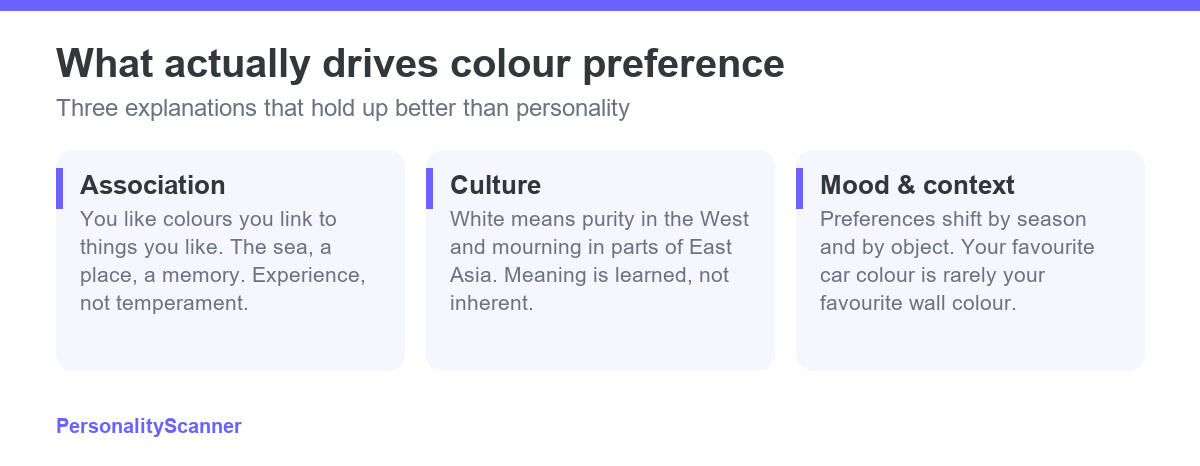
1. Association, not disposition
The best-supported explanation is simple: people tend to like colors they associate with things they like. Palmer and Schloss call this the ecological valence theory. When they asked people how much they liked objects of each color — clear skies and clean water for blue, rotting food for brown — those object ratings accounted for 80% of the variation in average color preference.
Their most memorable example involved school loyalty. Berkeley students who felt more school spirit liked Berkeley’s blue and gold more, and Stanford’s red less. The authors’ reading: students do not like Berkeley because of its colors; they like the colors because they like Berkeley.
This is why color preference feels personal — it is. It just reflects your experiences and attachments rather than your traits.
2. Culture and language
Color associations are partly shared and partly local. A study of 4,598 people in 30 countries found strong common patterns in which emotions people link to which colors, but also differences by country, with nearby countries and related languages being more alike. Any article telling you what a color “means” about a person has quietly assumed one culture’s version.
3. Mood and context
Ask yourself for your favorite color for a car, a sweater and a bedroom wall, and you may give three different answers. That tells you the question “what is your favorite color?” is underspecified. What you are choosing the color for, how you feel that day and what you have been seeing lately all play a part.
Why do color personality descriptions feel so accurate?
Because they are written to.
In a classroom demonstration published in 1949, psychologist Bertram Forer gave 39 students what he said were personal sketches based on a test they had taken. On a scale from 0 (poor) to 5 (perfect), the sketches were rated on average about 4.3. Every student had received the same 13 statements, which Forer had taken largely from a newsstand astrology book.
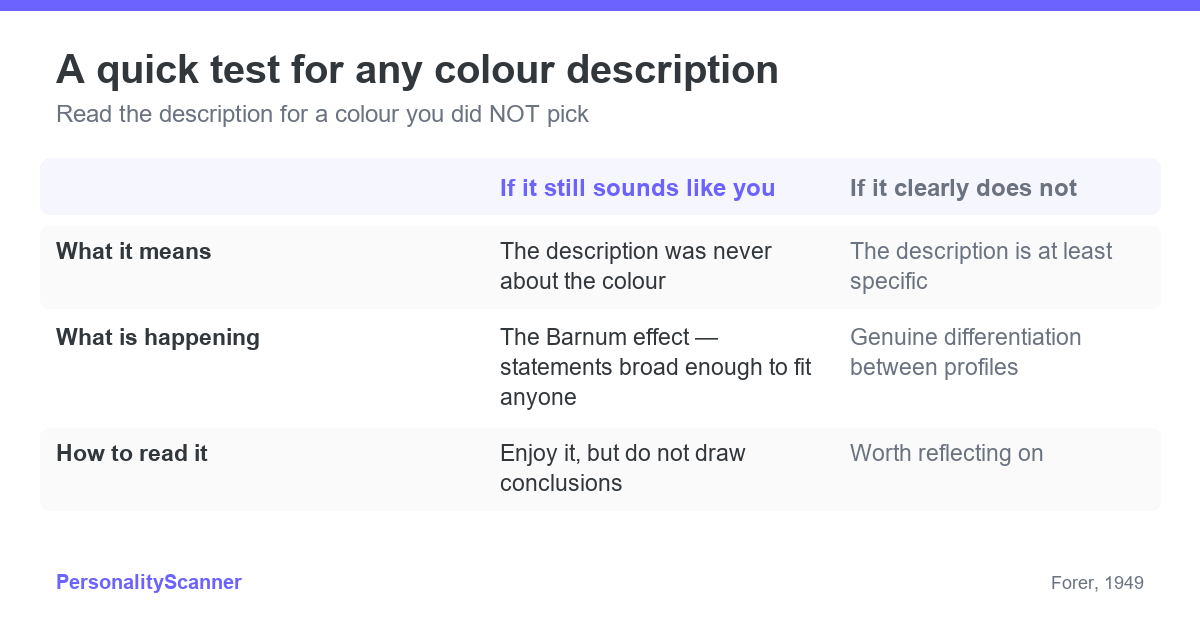
This is the Barnum effect, also called the Forer effect: we accept vague, broadly flattering statements as specifically true of us. Color-personality descriptions lean heavily on this kind of material. “You appear confident but sometimes doubt yourself.” “You value close friendships but need time alone.” These are true of nearly everyone.
A useful check: read the description for a color that is not your favorite. If it also sounds like you — and it usually will — the description was never about the color. We go deeper into this in how accurate are personality tests.
Where does color have a measurable effect?
None of this means color psychology is empty. There is careful research — it is about how color affects behavior in the moment, not what it reveals about identity.
A well-known 2009 paper in Science by Mehta and Zhu reported six studies in which red backgrounds improved performance on detail-oriented tasks while blue backgrounds improved performance on creative ones. The authors linked red to avoidance and vigilance and blue to approach and openness.
Effects like these are modest and depend on context, and not all of them replicate: a 2014 direct replication of one of Mehta and Zhu’s experiments, with more than three times as many participants, did not find the original effect. The direction of the research is still worth noting: color appears to influence how we perform in the moment, not who we are. Our color psychology explainer covers the evidence in more detail.
What can your favorite color honestly tell you?
Read as a prompt rather than a diagnosis, the question is still worth asking:
- What do you associate with it? The memory or place behind the preference is usually more revealing than the color itself.
- Has it changed? If your favorite shifted after a move, a new relationship or a new job, that shift tells you something about what you value now.
- Does it differ by context? Choosing calm colors for your home and bold ones for your clothes says something about how you want to feel versus how you want to be seen.
Those questions produce genuine self-knowledge. “You picked green, so you are harmonious” does not.
Frequently asked questions
What does your favorite color say about your personality?
Very little, reliably. A 2021 study tested 11 popular claims linking favorite colors to traits and found support for none. Preference mostly reflects personal associations, culture and context.
What is the most popular favorite color?
Blue. In a 2015 YouGov survey of ten countries it came first everywhere, chosen by 23% to 33% of people. Its popularity is itself a reason it cannot say much about individual personality.
Why do people like blue so much?
One leading explanation is association: blue is linked with things most people like, such as clear skies and clean water. In Palmer and Schloss’s research, liking for color-matched objects explained most of the differences in average color preference.
Does your favorite color change over time?
It can. Because preference is tied to associations, new experiences and attachments can shift it. Many people also give different answers depending on what the color is for.
Why do color personality descriptions feel so accurate?
The Barnum effect. The descriptions use statements broad enough to apply to almost anyone. Reading the description for a color you did not pick usually makes this obvious.
The bottom line
Your favorite color is a real preference with real causes — they are just associations, culture and context rather than temperament. Enjoy the question, be skeptical of anyone who answers it too confidently, and use a broader instrument if you want an actual picture of your personality.
Take the free color personality test for a fuller read than one color can offer, see the 4 color personality types for how workplace color models work, or try the Big Five personality test for the model psychologists actually use.
Sources
- Jonauskaite D, Thalmayer AG, Müller L, Mohr C. What does your favourite colour say about your personality? Not much. Personality Science, 2021.
- Palmer SE, Schloss KB. An ecological valence theory of human color preference. PNAS, 2010.
- YouGov. Why is blue the world’s favorite color? 2015.
- Jonauskaite D, et al. Universal patterns in color-emotion associations are further shaped by linguistic and geographic proximity. Psychological Science, 2020.
- Forer BR. The fallacy of personal validation: a classroom demonstration of gullibility. Journal of Abnormal and Social Psychology, 1949.
- Mehta R, Zhu RJ. Blue or red? Exploring the effect of color on cognitive task performances. Science, 2009.
- Steele KM. Failure to replicate the Mehta and Zhu (2009) color-priming effect on anagram solution times. Psychonomic Bulletin & Review, 2014.
Published by the PersonalityScanner Editorial Team. This article is educational and is not a diagnosis or medical advice.