Quick answer: The four attachment styles are secure, anxious (preoccupied), avoidant (dismissing) and disorganized (fearful-avoidant). They describe how a person tends to handle closeness, trust and conflict in relationships. In a large US national sample, 59% of adults described themselves as secure, and research shows the styles work more like two sliding scales than four fixed boxes. Take the free attachment style test to see where you fall.
Why does one person feel calm when a partner asks for space, while another feels a spike of panic? Attachment theory offers one of the best-researched answers. The way our early caregivers responded to us shapes a working template for relationships, and that template tends to show up again in adult friendships and romance.
This guide is the hub for our attachment series. Below you will find what each style looks like, where the four-style model comes from, how researchers actually measure attachment, and whether your style can change. For a deeper look at a single style, follow the links to the dedicated guides.
What are attachment styles?
Attachment theory began with John Bowlby and Mary Ainsworth, who studied how infants seek comfort from caregivers. Ainsworth described three infant patterns: secure, avoidant and anxious/ambivalent. Later researchers identified a fourth infant pattern, disorganized, in which a child shows contradictory or confused behavior toward the caregiver. A meta-analysis of nearly 80 studies found that about 15% of infants in typical middle-class families show disorganized attachment, with higher rates in high-risk settings.
In 1987, Cindy Hazan and Phillip Shaver applied these ideas to adult romantic love. Their questionnaire studies suggested that the three original styles appear in adults in roughly the same proportions as in infants, and that each style colors how people experience love.
The four attachment styles at a glance
In 1991, Kim Bartholomew and Leonard Horowitz proposed a four-category model for adults built on two questions: do you see yourself as worthy of love, and do you see other people as available and trustworthy? The combinations give four styles.
| Style | View of self | View of others | Typical pattern |
|---|---|---|---|
| Secure | Positive | Positive | Comfortable with closeness and with independence; raises needs directly. |
| Anxious (preoccupied) | Negative | Positive | Wants closeness but worries about being let down; seeks reassurance. |
| Avoidant (dismissing) | Positive | Negative | Values self-reliance; pulls back when things get emotionally intense. |
| Disorganized (fearful-avoidant) | Negative | Negative | Wants closeness and fears it; relationships can feel push-pull. |
1. Secure attachment
Securely attached people can depend on others without losing themselves and can spend time apart without feeling abandoned. In conflict they tend to say what they need and recover fairly quickly. In Mickelson, Kessler and Shaver’s 1997 study of a nationally representative US sample, 59% of adults chose the secure description. Read more in our guide to secure attachment.
2. Anxious attachment
Anxiously attached people want closeness but often doubt a partner’s availability. They may watch closely for signs of rejection, need frequent reassurance and feel intense distress when a partner seems distant. In the 1997 national sample, 11% described themselves this way. See anxious attachment style for signs and coping strategies.
3. Avoidant attachment
Avoidant people put a high value on independence and can feel uneasy when a relationship asks for more emotional closeness than they are used to. They may downplay how much relationships matter or withdraw under stress. In the same study, 25% chose the avoidant description. Our guides to avoidant attachment and how to heal an avoidant attachment style go further.
4. Disorganized (fearful-avoidant) attachment
In adults, the label “disorganized” usually refers to what Bartholomew and Horowitz called fearful attachment: a person both craves closeness and fears being hurt by it. The pattern can look like moving toward a partner and then retreating once closeness arrives. Popular writing often treats adult “disorganized” and “fearful-avoidant” as the same thing, but they come from different research traditions, one from infant observation and one from adult self-report. Read disorganized attachment style for the details.
Are attachment styles categories or dimensions?
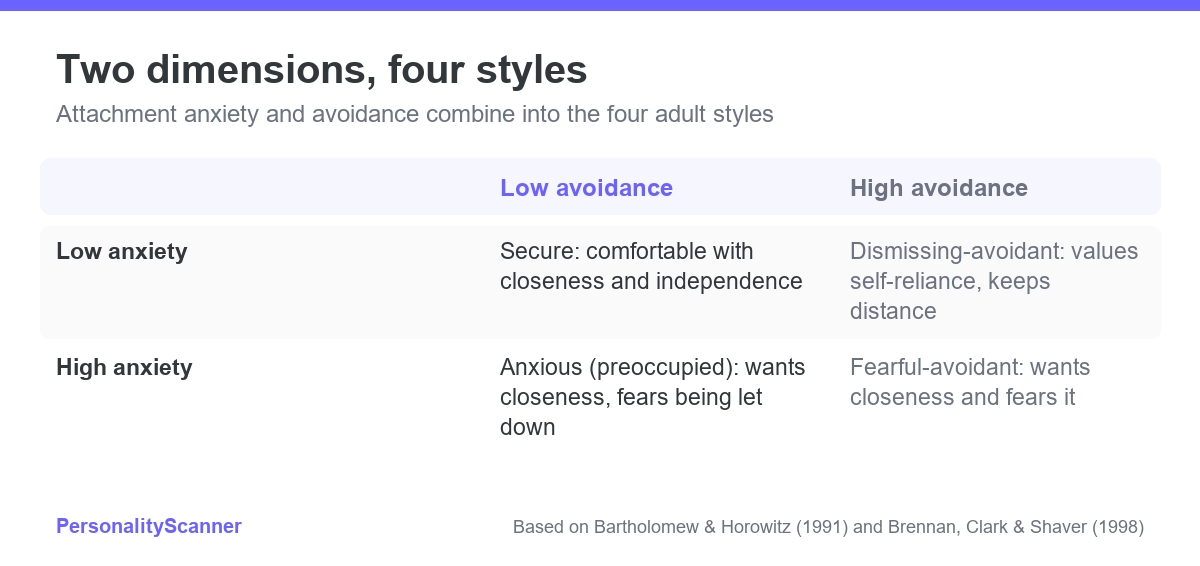
The four boxes are a useful shorthand, but most researchers now measure attachment on two continuous dimensions, an approach that grew out of work by Kelly Brennan, Catherine Clark and Phillip Shaver in 1998:
- Attachment anxiety: how much you worry about whether a partner will be there for you.
- Attachment avoidance: how uncomfortable you are depending on others and opening up.
Someone low on both is prototypically secure. High anxiety with low avoidance looks like the anxious style; high avoidance with low anxiety looks dismissing; high on both looks fearful. A 2015 taxometric study by R. Chris Fraley and colleagues tested whether people really fall into distinct types and concluded that attachment differences are better described as dimensions than categories.
That matters for how you read any test result, including ours. If your scores sit near the middle of a scale, the label you receive is less informative than the scores themselves. Our article on how accurate personality tests are explains why boundary scores are the least stable.
How is attachment measured?
Two very different kinds of measure exist, and they do not always agree.
- Self-report questionnaires such as the Experiences in Close Relationships scale ask how you feel and behave in relationships. Online tests, including the PersonalityScanner attachment style test, belong to this family.
- Interviews such as the Adult Attachment Interview ask people to describe childhood relationships and are scored on how coherently they talk about them, not on what they say happened.
Can your attachment style change?
Yes, at least to a degree. Fraley’s review of the evidence notes that attachment security is only moderately stable over long periods and that Bowlby himself expected change when new relationships contradict old expectations. What exactly drives change is still not well understood.
Researchers use the term earned security for adults who describe difficult childhoods coherently and are classified as secure. A 23-year longitudinal study by Glenn Roisman and colleagues found that people whose security was earned, defined using their infant records, went on to have successful close relationships. The picture is complicated, though: people labeled earned-secure from their own retrospective accounts did not always have the insecure early histories researchers assumed.
Practical routes people report include a stable relationship with a secure partner, reflection on their own patterns and therapy. If attachment worries are causing you real distress, a licensed therapist is the right person to talk to.
How attachment shows up in relationships
Styles interact. A common and painful pairing is one anxious and one avoidant partner: the more one seeks closeness, the more the other withdraws, which deepens the first partner’s worry. We cover this cycle in the anxious-avoidant relationship, and the related question of whether intense feelings are love or attachment.
Attachment is also distinct from broader personality. Frameworks such as the Big Five personality traits describe general tendencies like extraversion, while attachment describes how you handle closeness and dependence specifically. The two are related but answer different questions. Skills covered in our guide to emotional intelligence, such as naming and managing feelings, help with any style.
Frequently asked questions
What is the most common attachment style?
Secure. In a nationally representative US sample, 59% of adults described themselves as secure, 25% as avoidant and 11% as anxious, with a small share not classified.
What is the healthiest attachment style?
Secure attachment is generally considered the healthiest because it supports both intimacy and independence. Insecure styles are not disorders, though. They are patterns that made sense in earlier relationships and can shift over time.
Is fearful-avoidant the same as disorganized attachment?
They overlap but are not identical. Disorganized is an infant category based on observed behavior; fearful-avoidant is an adult category from Bartholomew and Horowitz’s model. Many popular sources use the terms interchangeably for adults.
Can you have more than one attachment style?
Your style can vary by relationship, for example with a parent versus a partner, and research suggests attachment is better measured as two dimensions than as one category. Most tests report your dominant tendency.
Is an attachment style test a diagnosis?
No. A questionnaire reflects how you see yourself in relationships right now. It is useful for reflection, not a clinical assessment.
Sources
- Hazan C, Shaver P. Romantic love conceptualized as an attachment process. Journal of Personality and Social Psychology, 1987.
- Bartholomew K, Horowitz LM. Attachment styles among young adults: a test of a four-category model. Journal of Personality and Social Psychology, 1991.
- Mickelson KD, Kessler RC, Shaver PR. Adult attachment in a nationally representative sample. Journal of Personality and Social Psychology, 1997.
- van IJzendoorn MH, Schuengel C, Bakermans-Kranenburg MJ. Disorganized attachment in early childhood: meta-analysis. Development and Psychopathology, 1999.
- Fraley RC, Hudson NW, Heffernan ME, Segal N. Are adult attachment styles categorical or dimensional? Journal of Personality and Social Psychology, 2015.
- Roisman GI, Padrón E, Sroufe LA, Egeland B. Earned-secure attachment status in retrospect and prospect. Child Development, 2002.
- Fraley RC. A brief overview of adult attachment theory and research. University of Illinois.
Published by the PersonalityScanner Editorial Team. This article is educational and is not a diagnosis or medical advice.