Quick answer: The Big Five personality traits are Openness, Conscientiousness, Extraversion, Agreeableness and Neuroticism (remembered as OCEAN). Each is a scale you sit somewhere along, not a box you fall into, and together they are the model most personality researchers use. Take the free Big Five test to see your own profile.
If you have ever wondered why one person thrives on spontaneity while another needs a detailed plan, personality science has a well-tested answer. The Big Five, also called the Five-Factor Model, describes personality with five broad dimensions that can be measured, that are fairly stable over time, and that show up across many languages and cultures.
This guide explains each trait, the smaller facets inside it, what the traits predict, and how much they change. If you prefer type-based systems, our guide to the 16 personality types covers that approach, and we compare the two below.
What are the Big Five personality traits?
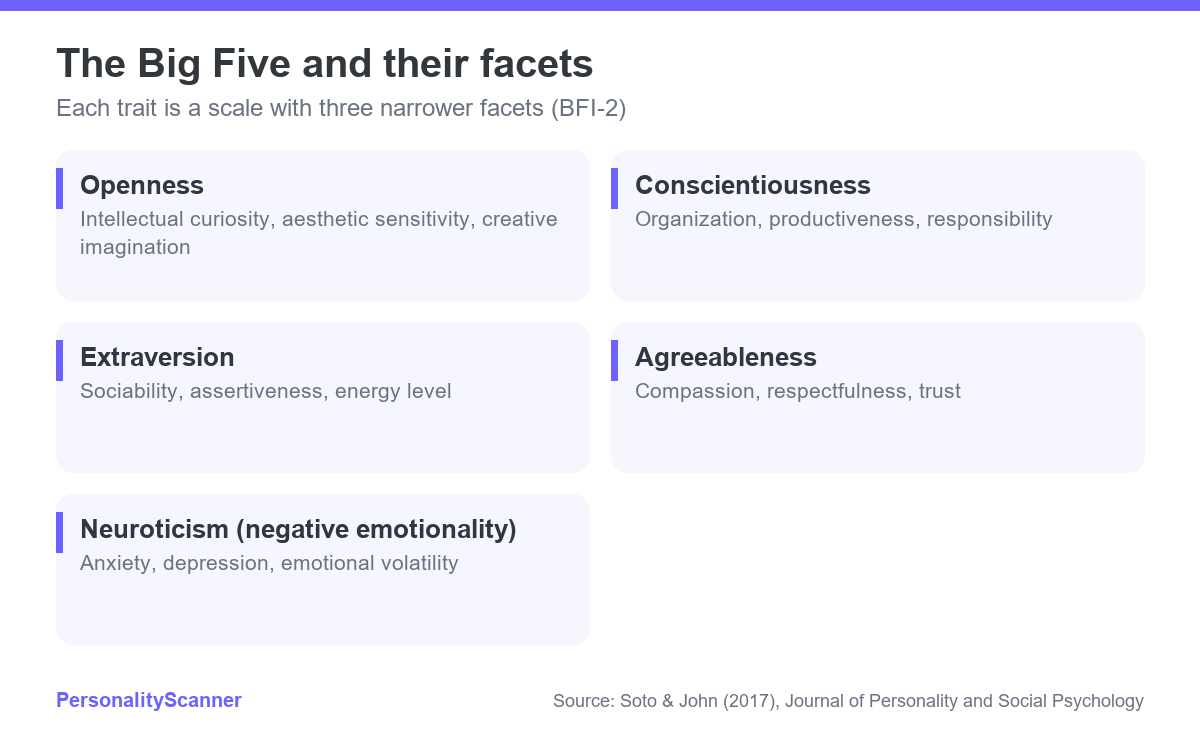
The five traits are broad summaries. Under each sits a cluster of narrower facets. The Big Five Inventory-2 (BFI-2), a widely used research questionnaire published by Christopher Soto and Oliver John in 2017, measures three facets per trait, 15 in total.
1. Openness to experience
Curiosity, imagination and a taste for new ideas, art and experiences. BFI-2 facets: intellectual curiosity, aesthetic sensitivity and creative imagination. People lower in openness tend to prefer the familiar, the practical and the proven.
2. Conscientiousness
Organization, self-discipline and follow-through. BFI-2 facets: organization, productiveness and responsibility. Lower scorers are more flexible and spontaneous, and more comfortable improvising than planning.
3. Extraversion
How much you seek out and draw energy from people and activity. BFI-2 facets: sociability, assertiveness and energy level. Introversion, the low end, is not the same as shyness or social anxiety. It is a preference for quieter, lower-stimulation settings.
4. Agreeableness
Warmth, cooperation and concern for others. BFI-2 facets: compassion, respectfulness and trust. Lower scorers are more skeptical and competitive, which can be useful in negotiation or critical review.
5. Neuroticism (negative emotionality)
The tendency to experience negative emotions such as worry, sadness and irritability, and to react strongly to stress. BFI-2 calls this trait negative emotionality, with facets of anxiety, depression and emotional volatility. The low end is often called emotional stability. A high score is a description of tendencies, not a diagnosis.
Read more about each trait in our upcoming deep dives on openness to experience, conscientiousness, agreeableness, extraversion vs introversion and neuroticism.
What do high and low scores look like?
Neither end of any trait is simply good or bad. Each end suits some situations better than others.
| Trait | Higher scores tend to be | Lower scores tend to be |
|---|---|---|
| Openness | Curious, imaginative, drawn to novelty and abstract ideas | Practical, conventional, comfortable with routine |
| Conscientiousness | Organized, dependable, goal-driven | Flexible, spontaneous, relaxed about plans |
| Extraversion | Sociable, talkative, energized by people | Reserved, independent, recharged by solitude |
| Agreeableness | Trusting, warm, cooperative | Skeptical, direct, competitive |
| Neuroticism | Sensitive to stress, prone to worry | Calm, even-tempered, slow to get upset |
Where did the Big Five come from?
The model was not invented by a single theorist. It grew out of the lexical approach: the idea that the most important differences between people end up encoded as words in everyday language. Researchers collected trait adjectives, had large samples rate themselves or others on them, and used statistics to see which words cluster together. Five broad clusters kept appearing.
A key test was whether the structure holds outside English. In a 1997 paper in American Psychologist, Robert McCrae and Paul Costa compared data from 7,134 people who took translated versions of their questionnaire in German, Portuguese, Hebrew, Chinese, Korean and Japanese. The same five-factor structure emerged, which they took as evidence that the structure may be universal. Later critics note that most of this research has used literate, urban samples, so “universal” is still debated.
What do the Big Five traits predict?
Personality traits are not destiny, but they do relate to real outcomes. Three well-known reviews:
- School and university grades. A 2009 meta-analysis by Arthur Poropat, with combined samples of over 70,000, found academic performance correlated with conscientiousness, agreeableness and openness. Conscientiousness predicted grades largely independently of intelligence.
- Health, relationships and careers. A 2007 review led by Brent Roberts looked only at prospective long-term studies. It found the effects of personality traits on mortality, divorce and occupational attainment were similar in size to the effects of socioeconomic status and cognitive ability.
- Mental and physical health. In a 2009 review, Benjamin Lahey described neuroticism as a robust predictor of many mental and physical disorders and of how often people use health services.
The effects are real but modest at the level of any one person. A trait score shifts the odds; it does not decide an outcome.
Can your Big Five traits change?
Yes, slowly. Two large reviews show both stability and change.
- Your ranking relative to others becomes more stable with age. Brent Roberts and Wendy DelVecchio pooled 152 longitudinal studies in 2000. Test-retest consistency rose from about .31 in childhood to .54 in the college years, .64 around age 30, and plateaued near .74 between ages 50 and 70.
- Average levels still shift. A 2006 meta-analysis of 92 samples by Roberts, Kate Walton and Wolfgang Viechtbauer found people on average become more socially dominant, more conscientious and more emotionally stable, especially between ages 20 and 40. Openness and social vitality rise in adolescence and decline in old age, and agreeableness changed mainly in old age.
In short, most adults become somewhat more organized, calmer and more confident over time, while still recognizably themselves.
Are the Big Five traits genetic?
Partly. A 2015 meta-analysis by Tena Vukasović and Denis Bratko pooled 62 independent estimates covering more than 100,000 people. On average, about 40% of the differences between people in personality were linked to genetic differences and about 60% to environmental influences. Twin studies gave higher estimates (.47) than family and adoption studies (.22).
Heritability describes differences across a population. It does not mean 40% of your personality is fixed by your genes, and it leaves plenty of room for experience to matter.
Big Five vs 16 personality types: what is the difference?
The core difference is scales versus categories. Type systems such as MBTI-style 16-type models sort you into one of a fixed set of boxes. The Big Five gives you a score on each continuous dimension, which matches how traits are actually distributed: most people sit near the middle, not at the extremes.
In a 1989 study, McCrae and Costa found that the four MBTI scales line up with four of the Big Five dimensions, but found no support for the idea that people fall into distinct types. Neuroticism has no clear counterpart in the 16-type system. Type frameworks can still be a friendly way into self-reflection. Our guide to the eight cognitive functions explains that tradition, and how accurate are personality tests? compares the evidence for each approach.
How to read your own Big Five results
- Look at percentiles, not labels. A score tells you where you sit compared with other people, not whether you “have” a trait.
- Trust the extremes more than the middle. Scores near the middle are the most likely to move on a retest.
- Consider context. Your traits interact with your situation. High neuroticism can make stress feel heavier; high conscientiousness can turn into rigidity under pressure.
- Use it alongside other lenses. Personality traits are different from relationship patterns (see attachment styles) and from emotional skills (see emotional intelligence).
Frequently asked questions
What does OCEAN stand for?
Openness, Conscientiousness, Extraversion, Agreeableness and Neuroticism. Some researchers rearrange the letters as CANOE; it is the same five traits.
Is the Big Five test accurate?
Well-built Big Five questionnaires are among the most reliable personality measures available, and their scores relate to real-life outcomes. Any self-report result still reflects how you see yourself at the time, so treat it as a useful estimate, not a verdict or a diagnosis.
Which Big Five trait is most important?
It depends on the outcome. Conscientiousness is the most consistent predictor of grades and work-related outcomes, while neuroticism is closely tied to stress and health. Each trait has situations where either end is an advantage.
Do Big Five traits change with age?
Yes, gradually. On average, conscientiousness and emotional stability increase through young adulthood and middle age, and your ranking relative to peers becomes more stable as you get older.
Is the Big Five better than the 16 personality types?
For research and prediction, yes: it measures continuous traits and has far more evidence behind it. Type systems are easier to remember and talk about, which is a different kind of usefulness.
Sources
- Soto CJ, John OP. The next Big Five Inventory (BFI-2). Journal of Personality and Social Psychology, 2017.
- McCrae RR, Costa PT. Personality trait structure as a human universal. American Psychologist, 1997.
- Poropat AE. A meta-analysis of the five-factor model of personality and academic performance. Psychological Bulletin, 2009.
- Roberts BW, Kuncel NR, Shiner R, Caspi A, Goldberg LR. The power of personality. Perspectives on Psychological Science, 2007.
- Lahey BB. Public health significance of neuroticism. American Psychologist, 2009.
- Roberts BW, DelVecchio WF. The rank-order consistency of personality traits from childhood to old age. Psychological Bulletin, 2000.
- Roberts BW, Walton KE, Viechtbauer W. Patterns of mean-level change in personality traits across the life course. Psychological Bulletin, 2006.
- Vukasović T, Bratko D. Heritability of personality: a meta-analysis of behavior genetic studies. Psychological Bulletin, 2015.
- McCrae RR, Costa PT. Reinterpreting the Myers-Briggs Type Indicator from the perspective of the five-factor model. Journal of Personality, 1989.
Published by the PersonalityScanner Editorial Team. This article is educational and is not a diagnosis or medical advice.