Quick answer: The Dark Triad is a set of three overlapping personality traits studied in psychology: narcissism (grandiosity and entitlement), Machiavellianism (strategic manipulation), and psychopathy (low empathy and impulsivity). They are measured as spectrums that everyone sits somewhere on — not as diagnoses or disorders. Take the free Dark Triad test to see where you fall.
The term sounds like something from a thriller, and that framing has done real damage to how people understand it. The Dark Triad is not a diagnosis, not a category of person, and not a way to identify villains.
It is a research construct: three traits that psychologists found tend to travel together, each measured on a continuum. Understanding what the research does and does not say is the difference between a useful concept and an internet insult.
Where the term comes from
The Dark Triad was introduced in 2002 by Delroy Paulhus and Kevin Williams in the Journal of Research in Personality. They noticed that three traits already studied separately kept correlating with one another, yet remained distinct enough to be worth separating.
Their central finding was nuanced and often lost in popular retellings: the three traits overlap but are not the same thing. They share a common core — roughly, a willingness to advance one’s own interests at others’ expense — while differing in motive, method, and impulse control.
The three traits
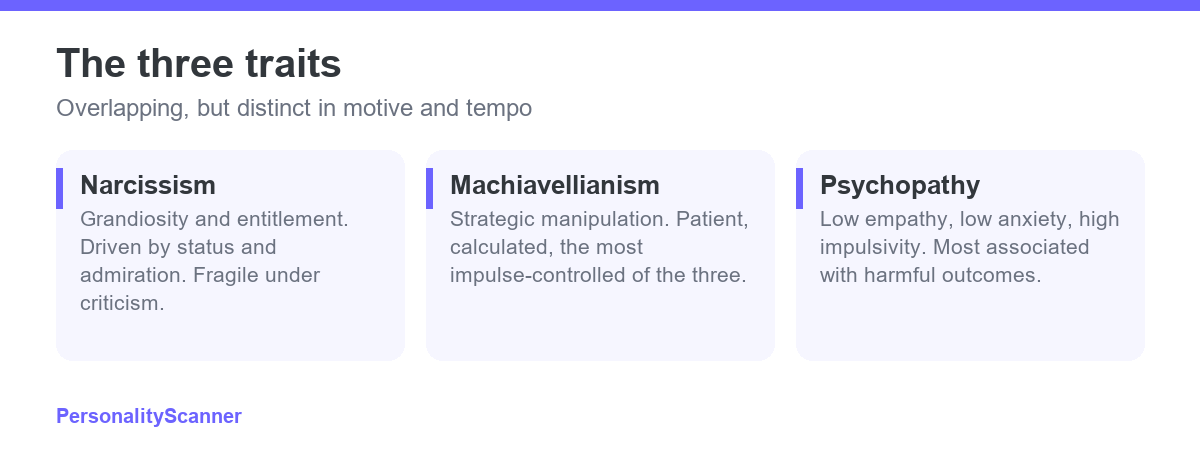
Narcissism
Characterised by grandiosity, a need for admiration, and a sense of entitlement. The subclinical version studied here is a normal-range personality trait, distinct from Narcissistic Personality Disorder, which is a clinical diagnosis made by qualified professionals against specific criteria.
The driving motive is status and validation. Someone high in narcissism wants to be seen as exceptional, and their self-image depends on external confirmation. Research consistently finds it correlates with confident first impressions that tend to degrade over longer acquaintance.
Machiavellianism
Named after Niccolò Machiavelli’s The Prince, this trait describes a strategic, cynical approach to other people. High scorers tend to endorse the view that manipulation is an acceptable tool and that most people are exploitable.
The distinguishing feature is planning. Where narcissism seeks admiration and psychopathy acts on impulse, Machiavellianism is patient and instrumental. It is the most calculated of the three — long time horizons, controlled emotional display, reputation managed deliberately.
Psychopathy
In this context, subclinical psychopathy refers to a trait combination of low empathy, low anxiety, high impulsivity, and thrill-seeking. It is not the clinical or forensic construct associated with criminality, and it is not a diagnosis.
Of the three, research generally identifies this one as the most strongly associated with harmful outcomes — largely because low empathy combined with poor impulse control removes both the internal brake and the forward planning that might otherwise limit damage.
What the three share, and what separates them
All three involve a reduced weighting of other people’s interests. That shared core is why they correlate.
The differences matter just as much:
- Motive: narcissism wants admiration; Machiavellianism wants advantage; psychopathy wants stimulation.
- Time horizon: Machiavellianism plans; psychopathy acts now; narcissism responds to the audience available.
- Emotional reactivity: narcissism is fragile under criticism; Machiavellianism is controlled; psychopathy is low in anxiety generally.
- Impulse control: highest in Machiavellianism, lowest in psychopathy.
This is why a single “dark” score tells you less than the shape across all three.
How it is measured
Two instruments dominate the research literature:
- The Short Dark Triad (SD3), developed by Jones and Paulhus, uses 27 items to produce three separate subscale scores.
- The Dirty Dozen, developed by Jonason and Webster, is a 12-item measure favoured when survey space is tight.
Both are self-report questionnaires, and that matters. Self-report has a structural weakness with these traits in particular: the people highest in Machiavellianism are, by definition, the most inclined to manage how they appear. Scores should be read as indications, not verdicts.
Important: these are traits, not diagnoses
This is the part most often mangled online, so it is worth stating plainly.
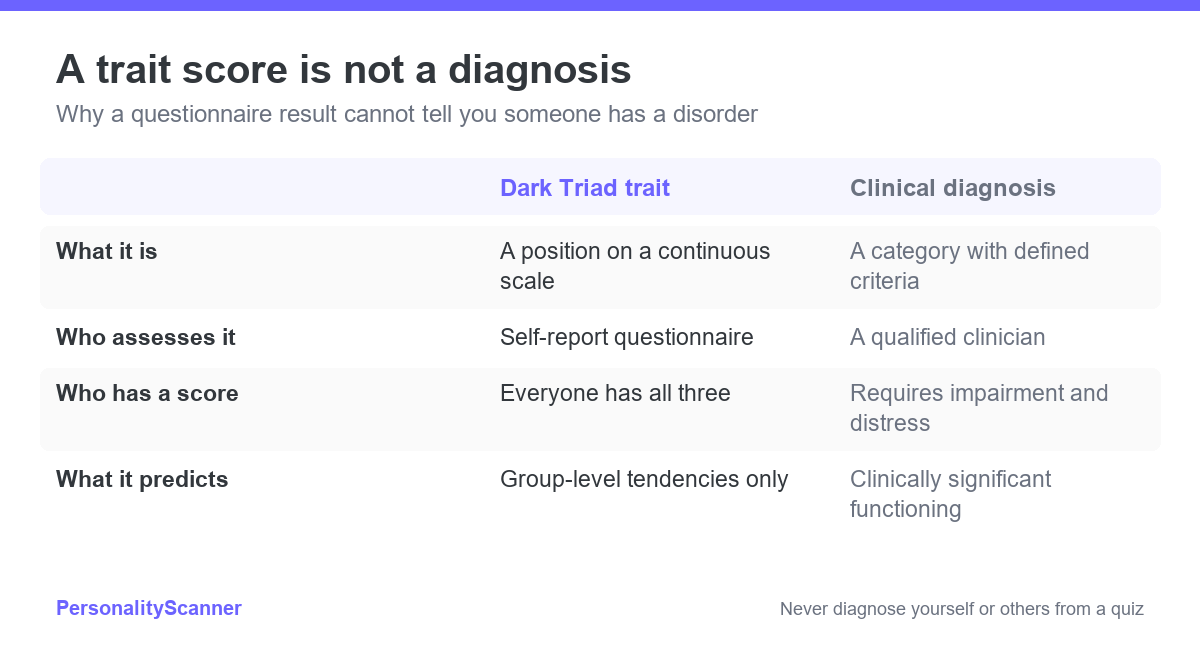
Everyone has a score on all three. The traits are continuous. Scoring above average does not place you in a category, does not mean you have a disorder, and does not mean you are dangerous. Elevated scores are common in the general population.
Narcissistic Personality Disorder and Antisocial Personality Disorder are clinical diagnoses. They require assessment by a qualified clinician against defined criteria, including significant impairment and distress. A questionnaire score is not equivalent and cannot substitute for one.
Do not use this to diagnose other people. Applying trait labels to an ex-partner, a colleague, or a family member from a distance is not assessment — it is a way of ending curiosity about a relationship early. If a relationship is harming you, the useful question is what the behaviour is doing to you, not what label fits the other person.
What research associates with elevated scores
Studies have linked higher Dark Triad scores with short-term mating strategies, workplace counterproductive behaviour, and certain leadership emergence patterns — people high in these traits often make strong first impressions and are disproportionately likely to put themselves forward.
Two cautions on reading any of that. These are group-level correlations, usually modest in size, and they do not predict individual behaviour reliably. And correlation is not destiny: a high score describes a tendency, not a fixed future.
It is also worth noting that some associated attributes — confidence, comfort with risk, emotional composure under pressure — are situationally useful. The research does not describe a simple gradient from good people to bad people.
Frequently asked questions
Is the Dark Triad a mental illness?
No. These are normal-range personality traits measured on a continuum. The related clinical diagnoses are separate constructs requiring professional assessment.
Can someone score high on one trait but low on the others?
Yes, and it is common. The traits correlate but remain distinct. Someone can score high on Machiavellianism while scoring low on psychopathy — a calculating but impulse-controlled profile.
Can Dark Triad traits change over time?
Personality traits are relatively stable in adulthood but not fixed. Research on trait change generally shows gradual shifts across the lifespan, with some traits softening with age.
Is there a “Dark Tetrad”?
Yes. Some researchers add everyday sadism — taking pleasure in others’ discomfort — as a fourth trait, arguing it explains behaviour the original three do not fully account for.
What should I do if I score higher than I expected?
Treat it as information, not a verdict. Self-report scores are noisy, and a single questionnaire on a single day is weak evidence. If you are genuinely concerned about how you relate to other people, that is a good conversation to have with a qualified professional.
The bottom line
The Dark Triad is a useful research framework and a poor insult. Three overlapping traits, each a spectrum, each with a different motive and tempo, all present in everyone to some degree. The value is in understanding the pattern — not in sorting people into heroes and villains.
Take the free Dark Triad test to see your profile across all three traits, and read it as a description of tendencies rather than a diagnosis.
Sources: Paulhus DL, Williams KM. “The Dark Triad of personality: Narcissism, Machiavellianism, and psychopathy.” Journal of Research in Personality, 2002. Jones DN, Paulhus DL, “Introducing the Short Dark Triad (SD3),” Assessment, 2014. Jonason PK, Webster GD, “The Dirty Dozen,” Psychological Assessment, 2010.
Published by the PersonalityScanner Editorial Team. This article is educational and is not a diagnosis or medical advice. If you are concerned about your wellbeing or someone else’s behaviour, speak to a qualified professional.