Why Mental Health Awareness Colors Matter
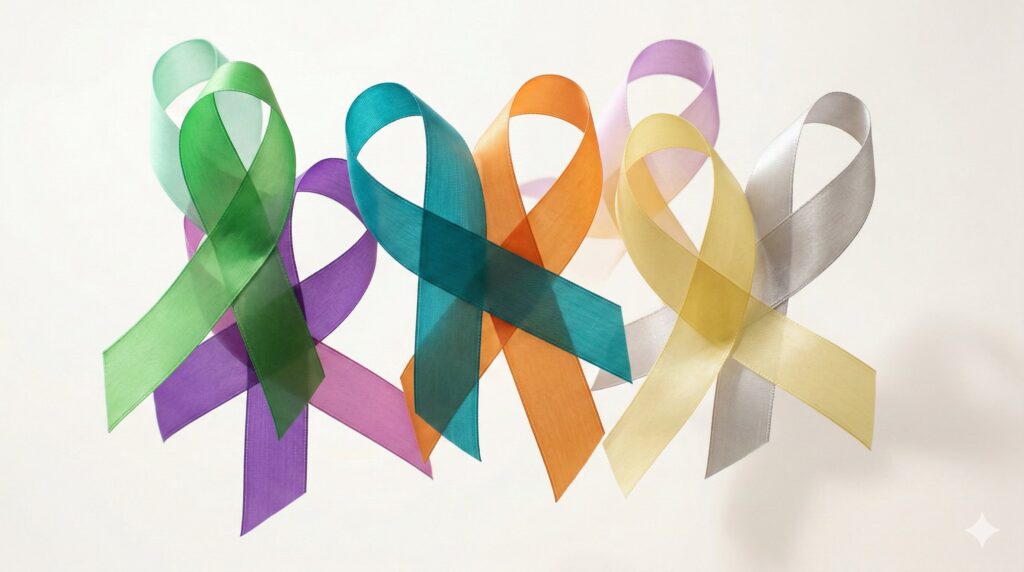
Awareness ribbons have been used for decades to signal support for various causes, and mental health is no exception. Each mental health awareness color represents a specific condition, cause, or community — serving as a visible symbol that reduces stigma, sparks conversation, and connects people who may feel isolated in their struggles.
Understanding what each color represents helps you show informed support, whether you are wearing a ribbon, sharing on social media, or participating in awareness events. This guide covers every major mental health awareness color, its meaning, its history, and how you can get involved.
Green: General Mental Health Awareness
Green is the most widely recognized mental health awareness color. It represents mental health awareness broadly and is the official color of Mental Health Awareness Month, observed every May in the United States.
What Green Represents
- Overall mental health awareness and education
- Destigmatization of mental illness
- Support for mental health funding and policy
- Solidarity with anyone affected by mental health conditions
History
The green ribbon for mental health awareness gained widespread adoption in the 1990s. Mental Health America (MHA), one of the oldest mental health advocacy organizations in the United States, popularized the green ribbon as part of their ongoing awareness campaigns. The color green was chosen to symbolize new life, growth, and vitality — values that align with recovery and hope.
How to Participate
- Wear a green ribbon or green clothing during Mental Health Awareness Month (May)
- Share mental health resources on social media using hashtags like #MentalHealthAwareness and #GreenRibbon
- Organize or attend community mental health events
- Donate to mental health organizations like NAMI, MHA, or local mental health nonprofits
Teal: Anxiety Disorders, OCD, and PTSD
Teal ribbons represent anxiety disorders, obsessive-compulsive disorder (OCD), and post-traumatic stress disorder (PTSD). These conditions affect hundreds of millions of people worldwide, making teal one of the most personally relevant awareness colors for many individuals.
What Teal Represents
- Generalized anxiety disorder (GAD)
- Social anxiety disorder
- Panic disorder
- Obsessive-compulsive disorder (OCD)
- Post-traumatic stress disorder (PTSD)
- Agoraphobia and specific phobias
Key Facts
Anxiety disorders are the most common mental health conditions globally, affecting an estimated 301 million people according to the World Health Organization. Despite their prevalence, many people with anxiety disorders go years without diagnosis or treatment due to stigma and misunderstanding.
How to Participate
- Wear teal during PTSD Awareness Month (June) or OCD Awareness Week (second week of October)
- Share accurate information about anxiety disorders to counter common misconceptions
- Support organizations like the Anxiety and Depression Association of America (ADAA) and the International OCD Foundation
Orange: ADHD and Self-Harm Awareness
Orange serves double duty in the mental health awareness space, representing both attention-deficit/hyperactivity disorder (ADHD) and self-harm awareness.
What Orange Represents
- ADHD awareness and advocacy
- Self-harm awareness and prevention
- Understanding neurodivergent experiences
ADHD Awareness
ADHD Awareness Month is observed in October. The orange ribbon symbolizes advocacy for better understanding of ADHD as a neurodevelopmental condition, not a behavioral choice or character flaw. ADHD affects approximately 5-7% of children and 2-5% of adults worldwide, yet it remains widely misunderstood.
Self-Harm Awareness
Self-Injury Awareness Day (SIAD) is observed on March 1. Orange and orange-accented awareness campaigns focus on reducing the shame and secrecy that surround self-harm, encouraging those who struggle to seek help, and educating the public about the complex psychological factors that drive self-injurious behavior.
How to Participate
- Wear orange during ADHD Awareness Month (October) or on Self-Injury Awareness Day (March 1)
- Share evidence-based resources about ADHD and self-harm
- Support organizations like CHADD (Children and Adults with ADHD) and the Self-Injury Outreach and Support network
Purple: Eating Disorders, Alzheimer’s, and Domestic Violence
Purple ribbons represent several overlapping causes in the mental health and wellness space, including eating disorders, Alzheimer’s disease and dementia awareness, and domestic violence.
What Purple Represents
- Eating disorders (anorexia, bulimia, binge eating disorder, ARFID)
- Alzheimer’s disease and dementia awareness
- Domestic violence awareness
- Lupus awareness (which has significant mental health impacts)
Eating Disorder Awareness
National Eating Disorders Awareness Week (NEDAwareness Week) typically takes place in late February. Eating disorders have the highest mortality rate of any mental illness, yet many people still view them as lifestyle choices rather than serious psychiatric conditions. The purple ribbon helps challenge this dangerous misconception.
Alzheimer’s and Dementia
Purple is also the signature color for Alzheimer’s awareness. World Alzheimer’s Month is observed in September, with the purple ribbon representing solidarity with the millions of individuals and families affected by dementia.
How to Participate
- Wear purple during NEDAwareness Week (February) or World Alzheimer’s Month (September)
- Share accurate information about eating disorders to combat myths
- Support organizations like NEDA (National Eating Disorders Association) and the Alzheimer’s Association
Yellow and Gold: Suicide Prevention
Yellow and gold ribbons represent suicide prevention and awareness. These colors carry profound significance given the global impact of suicide, which claims over 700,000 lives annually according to the WHO.
What Yellow Represents
- Suicide prevention and awareness
- Support for suicide loss survivors
- Encouragement for help-seeking behavior
History
The yellow ribbon for suicide prevention traces back to the story of Mike Emme, a 17-year-old from Colorado who died by suicide in 1994. His parents and friends created the Yellow Ribbon Suicide Prevention Program, distributing cards that read: “This ribbon is a lifeline. It carries the message that I am not able to talk about it right now, but I need help. No hassles. No judgments.”
How to Participate
- Wear yellow on World Suicide Prevention Day (September 10) and throughout Suicide Prevention Awareness Month (September)
- Learn and share the warning signs of suicide
- Save and distribute crisis resources: the 988 Suicide and Crisis Lifeline (call or text 988 in the US), Crisis Text Line (text HOME to 741741)
- Support organizations like the American Foundation for Suicide Prevention (AFSP)
Silver: Mental Health in General and Brain Disorders
Silver ribbons represent a broad category of brain-related conditions, including mental illness generally, Parkinson’s disease, and brain disorders.
What Silver Represents
- Mental illness awareness (broad category)
- Brain disorders and neurological conditions
- Parkinson’s disease awareness
- Schizophrenia and psychotic disorders
The silver ribbon is often used as a general symbol for mental health advocacy when a more specific color does not apply or when the goal is to represent the full spectrum of mental health conditions.
Burgundy: Brain Injury and Migraine
Burgundy ribbons represent traumatic brain injury (TBI), acquired brain injury, and migraine awareness. While these conditions are often classified as neurological rather than psychiatric, they have significant mental health implications including depression, anxiety, personality changes, and cognitive difficulties.
How to Participate
- Wear burgundy during Brain Injury Awareness Month (March) or Migraine and Headache Awareness Month (June)
- Advocate for better screening and support for mental health impacts of brain injuries
- Support organizations like the Brain Injury Association of America
Periwinkle Blue: Eating Disorders (Alternate)
Periwinkle blue is sometimes used as an alternative or complementary color for eating disorder awareness, particularly in campaigns that want to differentiate from the broader purple ribbon category.
What Periwinkle Represents
- Eating disorder awareness and recovery
- Body image issues and body dysmorphic disorder
- Support for families affected by eating disorders
Complete Mental Health Awareness Color Reference
Here is a quick-reference summary of every major mental health awareness color and its associated cause:
- Green: General mental health awareness (May)
- Teal: Anxiety, OCD, PTSD (June for PTSD, October for OCD)
- Orange: ADHD (October), Self-harm (March 1)
- Purple: Eating disorders (February), Alzheimer’s (September), Domestic violence (October)
- Yellow/Gold: Suicide prevention (September)
- Silver: Mental illness broadly, brain disorders, schizophrenia
- Burgundy: Brain injury (March), Migraine (June)
- Periwinkle Blue: Eating disorders (alternate)
- Red: Heart disease and its mental health impacts, substance abuse (Red Ribbon Week in October)
- Black: Sleep disorders, mourning and grief
How to Make a Difference Beyond Wearing a Ribbon
Wearing a mental health awareness color is a meaningful first step, but lasting change requires more than symbolism. Here are concrete ways to turn awareness into action:
- Educate yourself. Read about mental health conditions from reputable sources like NIMH, WHO, and NAMI. Understanding reduces stigma.
- Check in on people. A simple “How are you really doing?” can open doors. Many people struggling with mental health issues feel invisible.
- Advocate for policy change. Contact your elected representatives to support mental health funding, insurance parity, and access to care.
- Donate your time or money. Mental health organizations at every level — from national nonprofits to local crisis centers — need support.
- Share your story. If you are comfortable doing so, sharing your own mental health experiences helps normalize the conversation and encourages others to seek help.
- Create a supportive environment. Whether at home, at work, or in your community, foster spaces where people feel safe discussing mental health without judgment.
Frequently Asked Questions
What is the official color for Mental Health Awareness Month?
Green is the official mental health awareness color for Mental Health Awareness Month, which is observed every May. The green ribbon was popularized by Mental Health America and symbolizes growth, renewal, and hope for recovery.
What color ribbon represents anxiety?
Teal is the awareness color for anxiety disorders, including generalized anxiety disorder, social anxiety, panic disorder, and phobias. Teal also represents OCD and PTSD awareness.
What color represents depression?
There is no single universally agreed-upon color exclusively for depression. Green (general mental health) is most commonly used, though some campaigns use blue to represent depression specifically. The blue and green combination is also sometimes used to represent co-occurring depression and anxiety.
When is Mental Health Awareness Month?
In the United States, Mental Health Awareness Month is observed every May. It was established in 1949, making it one of the longest-running awareness campaigns in the country. Other key dates include World Mental Health Day on October 10 (organized by the WHO).
Can I wear multiple awareness colors at the same time?
Absolutely. Many people affected by mental health conditions have comorbid diagnoses, and wearing multiple colors is a valid way to show support for all the causes that matter to you. Some advocates create multi-colored ribbons or wear several pins to represent the complexity of mental health.
Where can I get mental health awareness ribbons?
Mental health awareness ribbons are available from organizations like NAMI, Mental Health America, and the American Foundation for Suicide Prevention. Many are available for free or for a small donation. You can also make your own using ribbon in the appropriate color.
For further reading from trusted sources, visit National Alliance on Mental Illness (NAMI).
Disclaimer: This article is for educational purposes only. If you or someone you know is experiencing a mental health crisis, please contact the 988 Suicide and Crisis Lifeline (call or text 988 in the US), the Crisis Text Line (text HOME to 741741), or your local emergency services. You are not alone, and help is available.