Quick answer: The four color personality types are Red (direct, driven), Blue (analytical, precise), Green (steady, caring) and Yellow (sociable, enthusiastic). They come from workplace training tools built on Carl Jung’s ideas, not from academic personality research, and almost nobody is one pure color — most people blend two. A second popular system, True Colors, uses Orange, Gold, Green and Blue instead. Take the free color personality test to see your mix.
If you have sat through a corporate training day, you have probably been handed a color. Someone announced you were a Red, or a Yellow, and the room rearranged itself into four corners.
The four-color model is useful as shared vocabulary. It is also widely misunderstood. Here is where it comes from, what each color describes, how it differs from the other “four colors” test you may have taken at school, and what it can and cannot tell you. For the model researchers actually use, see our guide to the Big Five personality traits.
Where do the four personality colors come from?
The color labels are recent; the ideas underneath are about a century old.
Carl Jung’s book Psychological Types, first published in German in 1921, proposed that people differ in attitude (introversion or extraversion) and in function (thinking, feeling, sensation and intuition). Jung’s framework later influenced the MBTI-style 16 types and, more directly, the color systems used in workplace training.
The best-known red, blue, green and yellow system, Insights Discovery, says in its own practitioner materials that each color is a combination of two Jungian preferences:
- Red = extraversion + thinking
- Yellow = extraversion + feeling
- Green = introversion + feeling
- Blue = introversion + thinking
A separate tradition reaches a similar four-way split. In his 1928 book Emotions of Normal People, William Moulton Marston described four kinds of emotional behavior — dominance, inducement, submission and compliance. That became the basis of the DISC model, which uses letters rather than colors but sorts behavior in a comparable four-quadrant way.
The important detail: the colors are a memory aid. They make a two-dimension model easy to remember and discuss in a room full of people who will never read a psychology paper. They were not derived from any finding that personality comes in four kinds.
What does each color mean?
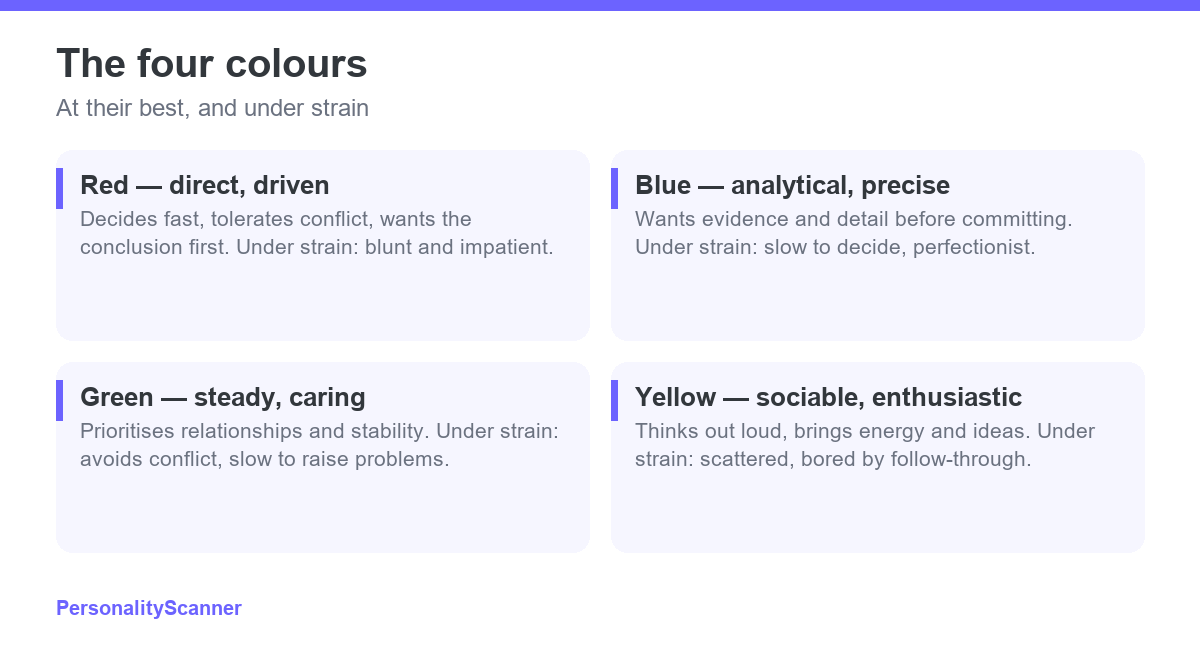
Red — direct and driven
Task-focused and fast-moving. Reds tend to decide quickly, tolerate conflict comfortably, and want the conclusion before the reasoning. They are usually the person who asks “so what are we actually doing?” twenty minutes into a meeting.
At their best: decisive, resilient under pressure, willing to make an unpopular call.
Under strain: impatient, blunt, inclined to steamroll quieter people.
Blue — analytical and precise
Task-focused but slower-moving by preference. Blues want the evidence, the detail and the caveats. They are uncomfortable committing to a position before they have checked it, and they notice inconsistencies that everyone else has skimmed past.
At their best: rigorous, thorough, the person who catches the error before it ships.
Under strain: slow to decide, perfectionist, prone to analysis that never converges.
Green — steady and caring
People-focused and slower-moving. Greens prioritize relationships and stability. They notice when someone in the room has gone quiet, and they will absorb a fair amount of personal inconvenience to avoid a confrontation.
At their best: loyal, patient, the person who holds a team together.
Under strain: conflict-avoidant, slow to raise problems, resistant to change.
Yellow — sociable and enthusiastic
People-focused and fast-moving. Yellows think out loud, generate ideas rapidly, and bring energy into a room. They are usually the reason a meeting was enjoyable and occasionally the reason it achieved nothing.
At their best: persuasive, creative, good at getting people moving.
Under strain: scattered, over-promising, bored by follow-through.
What are the two axes behind the colors?
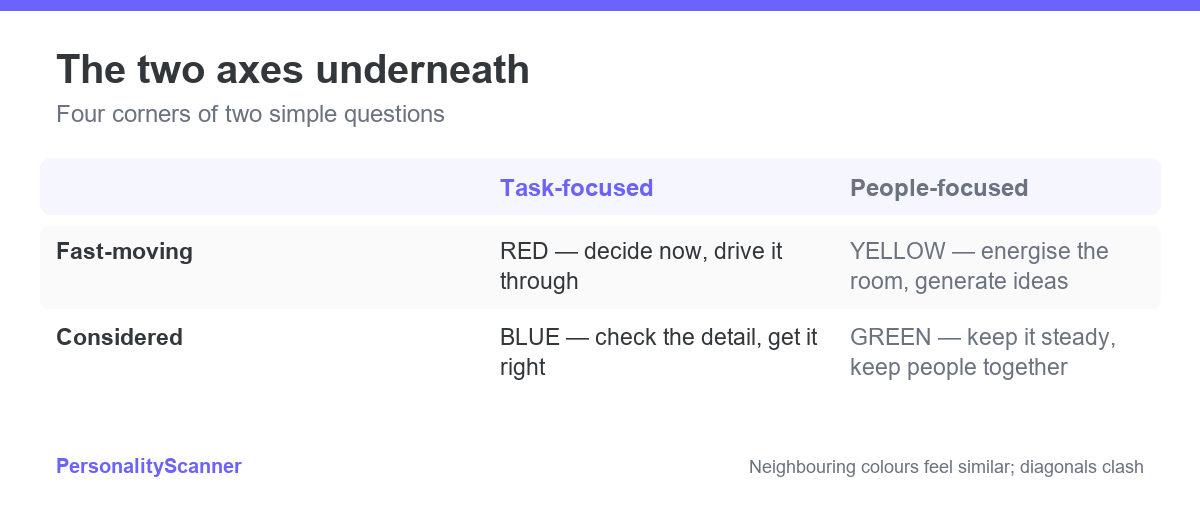
Once you see the structure, the four colors stop looking arbitrary. They are the four corners of two simple questions:
- Fast or considered? Red and Yellow move quickly. Blue and Green take their time. This is roughly Jung’s extraversion versus introversion.
- Task or people? Red and Blue focus on the work. Green and Yellow focus on the humans doing it. This is roughly Jung’s thinking versus feeling.
Red is fast and task-focused. Yellow is fast and people-focused. Blue is considered and task-focused. Green is considered and people-focused. That is the entire model.
It also explains why neighboring colors feel similar and diagonal ones feel foreign. Red and Blue share a task focus and mostly disagree about pace. Red and Green differ on both axes, so they have the least common ground to start from.
Red, Blue, Green, Yellow vs True Colors: which four colors test did you take?
Many people search for “the 4 colors personality test” and find results that do not match what they took. That is because there are two popular systems.
True Colors was developed by Don Lowry in 1978 and became popular largely because it is simple to remember. It uses Gold, Orange, Blue and Green as four temperaments, and like the workplace systems it treats everyone as a mix, with one “brightest” color and one “palest.” A University of Florida extension guide notes that the True Colors types correspond roughly to the judging, perceiving, feeling and thinking preferences of the MBTI-style system.
| System | Colors | Rough meaning |
|---|---|---|
| Workplace (Insights-style) | Red | Assertive, results-driven |
| Workplace (Insights-style) | Blue | Analytical, precise |
| Workplace (Insights-style) | Green | Caring, patient |
| Workplace (Insights-style) | Yellow | Sociable, enthusiastic |
| True Colors | Gold | Orderly, loyal, rule-following |
| True Colors | Orange | Spontaneous, adventurous, fun-loving |
| True Colors | Blue | Relational, compassionate, nurturing |
| True Colors | Green | Analytical, logical, objective |
Watch the overlaps: Blue and Green mean nearly opposite things in the two systems. A True Colors Green (analytical) is closer to a workplace Blue, and a True Colors Blue (relational) is closer to a workplace Green. If a description of “your” color feels wrong, check which system the test used.
True Colors also lines up with the idea of four temperaments, which goes back much further than either system. We cover that history in the four temperaments.
Can you be more than one color?
Yes, and nearly everyone is. This is the part that gets lost the moment someone is handed a label.
The underlying preferences are continuous. You are not assigned to a corner; you sit somewhere on two sliding scales, and where you sit produces a blend. Both major systems say the same thing in their own materials. Most people have a dominant color and a clear secondary — a Red-Blue is a very different colleague from a Red-Yellow, even though both are “Reds.”
Your color also moves with context. Plenty of people are a decisive Red at work and a conflict-avoiding Green at home. If a description feels wrong, it is worth asking which version of you was answering the questions.
Is the four color personality test scientifically valid?
It is not a validated research instrument. The color systems are training tools. Academic personality psychology uses the Big Five, which measures five continuous traits and has decades of evidence behind it. If you want a grounded picture of your personality, that is the model to use, and our guide to how accurate personality tests are explains why.
It does help as shared language. Giving a team a common shorthand for “I need the detail before I can commit” versus “I need the decision now” defuses a lot of avoidable friction. The value is in the conversation, not the precision of the label.
It should never be used to sort people. A color describes a preferred style, not capability. Using it to decide who gets a role, a promotion or a project asks far more of the model than it can deliver.
Color descriptions can also feel uncannily accurate for reasons that have nothing to do with the model. We explain that effect, and what color preference really reflects, in what your favorite color says about you.
Frequently asked questions
What are the four color personality types?
In the workplace systems: Red (direct and driven), Blue (analytical and precise), Green (steady and caring) and Yellow (sociable and enthusiastic). They map onto two axes: how quickly someone prefers to move, and whether they focus on the task or the people.
What is the difference between True Colors and the red, blue, green, yellow model?
They are separate systems. True Colors uses Gold, Orange, Blue and Green, and its Blue (relational) and Green (analytical) mean roughly the reverse of Blue and Green in the workplace model. Check which one your test used before reading a description.
Can you be two colors?
Yes, and most people are. Nearly everyone has a dominant color and a secondary one, and the blend is usually more informative than the headline color.
Which color personality is the rarest?
There is no reliable answer. The commercial systems do not publish a standard population breakdown that can be compared, so any specific percentage you see quoted should be treated with caution.
Can your color change over time?
Your dominant preference tends to be fairly stable, but it shifts with context and can drift with age. Many people show one color at work and another at home.
The bottom line
Four colors, two axes, and a lot of blending in between — plus a second four-color system that uses some of the same names for different things. Treat the model as a convenient way to talk about working style and it earns its place. Treat it as a scientific measurement of who you are and it will mislead you.
Take the free color personality test to see your own blend, and read the result as a description of preference rather than a verdict. For the research on color itself, see color psychology: what the research shows.
Sources
- Jung CG. Psychologische Typen (Psychological Types). Rascher, Zurich, 1921.
- The Insights Group. Insights Discovery theory practitioner guide (sample copy): the four colour energies.
- Marston WM. Emotions of Normal People. Kegan Paul, Trench, Trubner, 1928.
- Wiley. Everything DiSC: our story (history of the DiSC model).
- Lamm AJ, Telg RW. Using the True Colors Personality Assessment to Strengthen Extension Programs. UF/IFAS Extension, AEC572, 2015 (reviewed 2024).
Published by the PersonalityScanner Editorial Team. This article is educational and is not a diagnosis or medical advice.