Quick answer: It depends entirely on the test. Trait-based measures like the Big Five show strong reliability and predictive validity in decades of research. Type-based tests that sort you into a category are far weaker — a substantial share of people get a different type on a retest weeks later. No online test is a diagnosis. Take the free Big Five test for the most evidence-backed option.
“Is this thing accurate?” is the right question to ask about any personality test. It is also the wrong question to ask on its own — because “accurate” hides two very different ideas that psychologists keep carefully apart.
Get the distinction and you can evaluate any test you encounter, including ours.
The two things “accurate” actually means
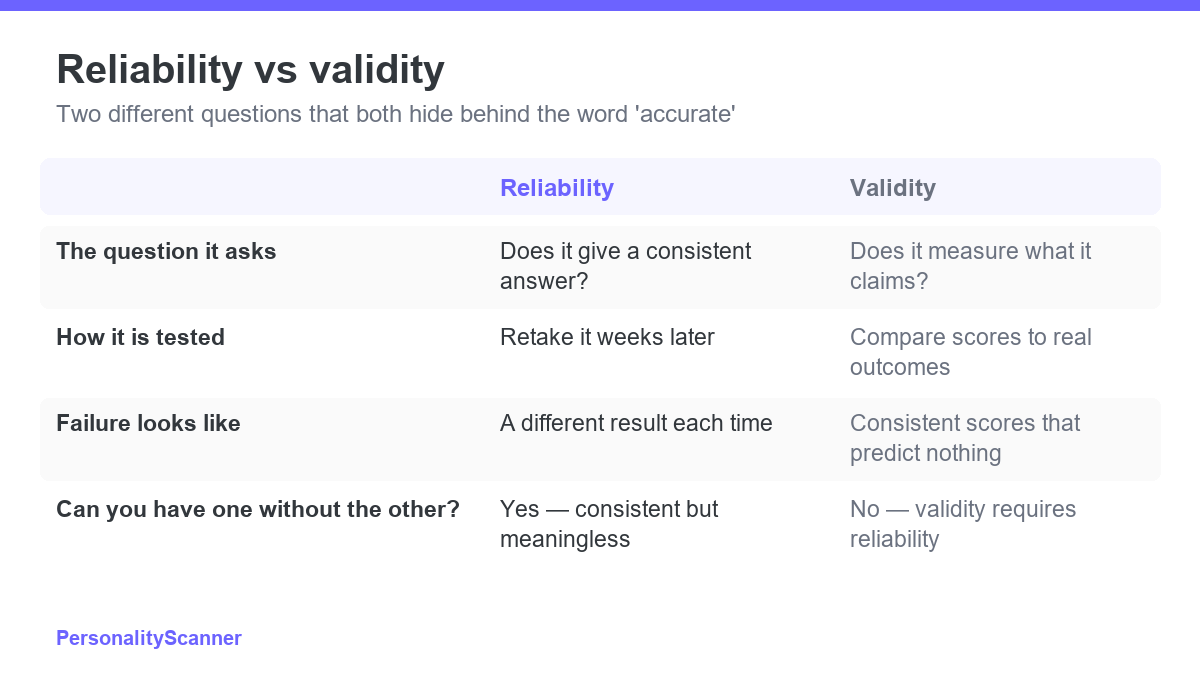
Reliability: does it give a consistent answer?
If you take a test today and again in six weeks, do you get roughly the same result? That is test-retest reliability. A bathroom scale that reads 70kg, then 84kg, then 61kg in one morning is unreliable — before you even ask whether it is calibrated correctly.
Validity: does it measure what it claims to?
A test can be perfectly consistent and still measure nothing useful. Predictive validity asks whether scores relate to real outcomes — job performance, relationship satisfaction, health behaviours. This is the harder bar, and the one where popular tests most often fail.
A test must be reliable to be valid, but reliability alone guarantees nothing.
Where trait tests stand
The Big Five — Openness, Conscientiousness, Extraversion, Agreeableness, Neuroticism — is the framework academic psychology actually uses, and it performs well on both measures.
Its structure has been recovered repeatedly across languages and cultures. The traits show substantial stability in adulthood, with gradual, predictable shifts across the lifespan. And they predict meaningful outcomes: conscientiousness in particular is one of the more consistent personality predictors of job performance and academic achievement across large meta-analyses.
None of that makes it perfect. Effect sizes are modest — personality explains part of the variance in life outcomes, not most of it. But as a measurement instrument it holds up. Read our full guide to the Big Five.
Where type tests struggle
Tests that sort you into one of a fixed number of types face a structural problem that has nothing to do with how well written they are.
Traits are continuously distributed. Most people cluster near the middle of any given dimension. But a type system has to draw a line and put you on one side of it. If you score close to that line — as a large share of people do — a small change in mood, context, or how you interpreted three ambiguous questions flips your entire category.
This is why retest studies on type-based instruments have repeatedly found that a substantial proportion of people receive a different type when retested weeks later. The underlying scores barely moved; the label moved because it was always sitting on a boundary.
Type systems remain genuinely popular for a reason — a four-letter code is memorable, shareable, and gives people useful vocabulary for talking about difference. That is a real benefit. It is just not the same thing as measurement accuracy.
The Barnum effect: why an inaccurate result still feels right
In 1948, psychologist Bertram Forer gave his students what he said were individually tailored personality profiles. Students rated the accuracy highly — around 4.3 out of 5.
Every student had received the identical text, assembled from a newsstand astrology column.
The Barnum effect is our tendency to accept vague, broadly applicable statements as specifically true of ourselves. Statements like “you have a great deal of unused capacity” or “at times you are extroverted, at other times reserved” feel personal while describing nearly everyone.
This is the single biggest reason a test can feel uncannily accurate while measuring very little. When you read a result, ask a hard question: would this description be false for most people I know? If not, it is not telling you much about you.
How to judge any personality test
A practical checklist:
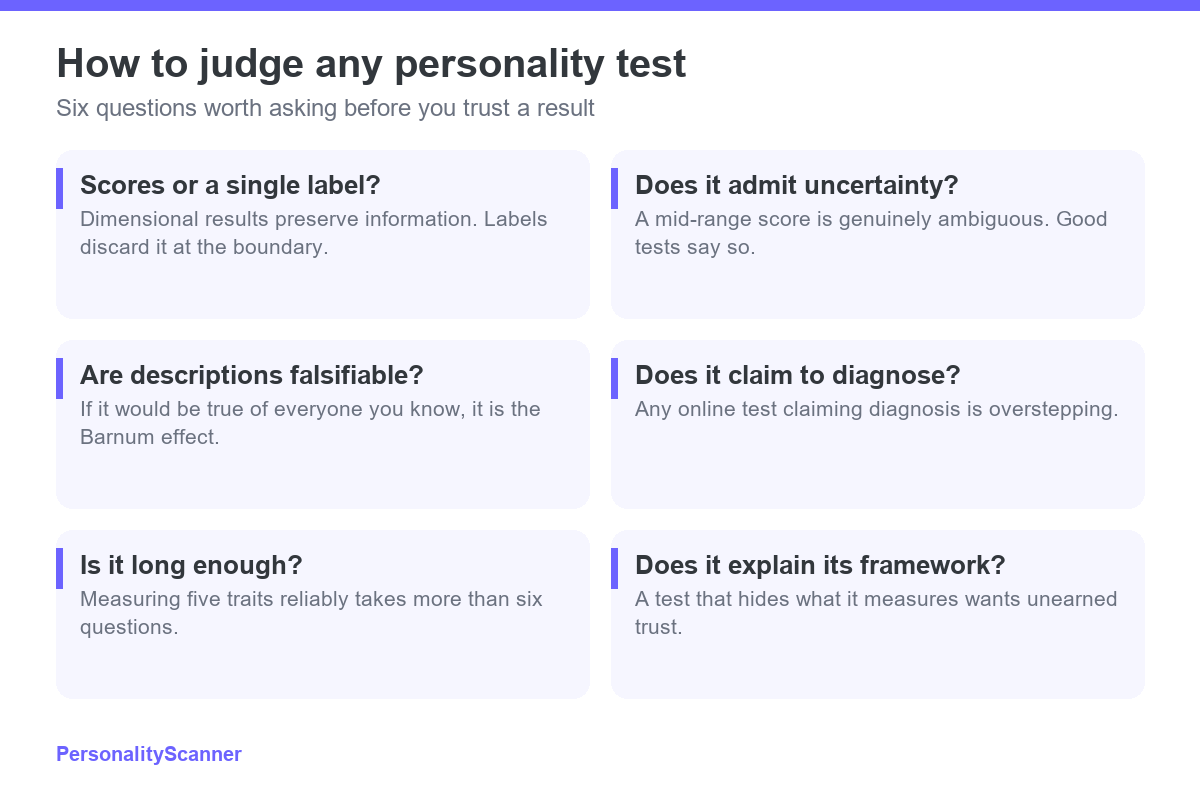
- Does it give you scores on dimensions, or a single label? Dimensional results preserve information; labels discard it.
- Does it acknowledge uncertainty? Good tests indicate that a score near the middle is genuinely ambiguous. Tests that declare your type with total confidence are overselling.
- Are the descriptions falsifiable? If every trait description is flattering and could apply to anyone, that is the Barnum effect at work.
- Does it claim to diagnose? Any online test claiming to diagnose a disorder is overstepping. Diagnosis requires a qualified clinician.
- Is it long enough? Reliable measurement of five traits generally needs a reasonable number of items. A six-question quiz cannot do it.
- Does it explain what it measures? A test that will not tell you its framework is asking for trust it has not earned.
What online tests are genuinely good for
Set against the right expectations, they are useful.
They provide vocabulary — words for patterns you had noticed but could not name. They prompt self-reflection, which has value independent of measurement precision. They offer a starting point for conversations about how you and other people differ. And where they are trait-based and well constructed, they give a reasonable estimate of where you sit relative to other people.
What they cannot do: diagnose a condition, predict your future, determine your career, or justify a decision about another person. A test result is one noisy data point about a complicated system, collected on a single day, filtered through your self-perception on that day.
How to read your own results
Three habits make results far more useful:
Pay attention to extremes, discount the middle. If you score near the ceiling or floor on a dimension, that is likely to be real and stable. Mid-range scores are the noisiest part of any test.
Look for what surprises you. The parts that match your self-image may just be confirming what you already believed. The genuinely informative result is the one you did not expect.
Retake it in a few months. What stays put is signal. What moves substantially was probably mood, context, or an ambiguous question you read differently on the day.
Frequently asked questions
Which personality test is the most scientifically accurate?
Among widely available tests, the Big Five has the strongest research support for both reliability and predictive validity, which is why it dominates academic research.
Why do I get different results each time I take a test?
Usually because your true score sits near a category boundary, or because mood and recent events shift how you answer. This is much more visible in type-based tests, where a small shift flips the whole label.
Are free online personality tests reliable?
Some are. Cost is not the signal — construction is. A free, well-built trait test with enough items can outperform a paid type test. Judge by the checklist above.
Can a personality test diagnose a mental health condition?
No. Screening tools can flag that a conversation with a professional might be worthwhile, but diagnosis requires qualified clinical assessment. Treat any online test claiming otherwise with real caution.
Do employers use personality tests?
Many do, most often trait-based measures. Their predictive value for job performance is real but modest, which is why they are best used as one input among several rather than as a filter.
Does personality change over time?
Yes, gradually. Research on trait development finds systematic shifts across the lifespan — conscientiousness and agreeableness tend to rise with age, while neuroticism tends to decline. Change is real but slow.
The bottom line
Good personality tests are useful instruments with real limits. Trait-based measures like the Big Five are reliable and modestly predictive. Type-based tests are engaging but unstable at the boundaries. And every result you read is filtered through a strong human tendency to agree with flattering, vague descriptions.
Read your results as a hypothesis about yourself, not a verdict. Take the free Big Five test to start with the most evidence-backed framework available.
Sources: Forer BR, “The fallacy of personal validation,” Journal of Abnormal and Social Psychology, 1949. McCrae RR, Costa PT, work on the Five-Factor Model. Roberts BW et al., research on personality trait change across the lifespan.
Published by the PersonalityScanner Editorial Team. This article is educational and is not a diagnosis or medical advice.